Get Full Government Meeting Transcripts, Videos, & Alerts Forever!
Get email alerts on the Longterm Care topic
No spam. Unsubscribe anytime.
Local memory workshop outlines care options, training and community dementia supports
Summary
At a Woodside‑area memory workshop, Sequoia Living and Kensington Place explained differences among independent living, assisted living, dedicated memory care and staff training approaches; attendees pressed presenters on costs, contracts and community dementia‑friendly training.
Susan, an event host for the Town of Woodside workshop, opened a hybrid presentation featuring local providers and Stanford experts.
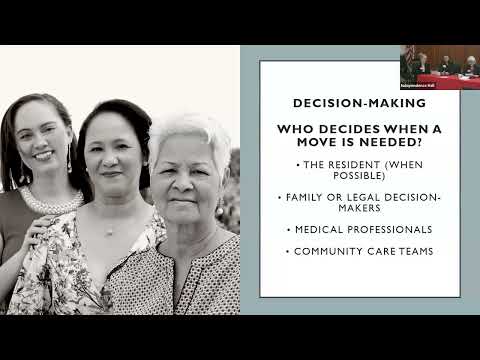
Sequoia Living executive director Sue Fairley described care pathways families commonly choose — independent living, assisted living, memory support and skilled nursing — and said transitions are driven by whether a living environment continues to meet a resident’s physical, social, emotional or safety needs. Fairley said Sequoia’s assessment process includes clinical and functional measures and cognitive screening such as the Montreal Cognitive Assessment, and that families and care teams are involved in decisions to keep residents at the center of planning. She also said communities that use an entrance‑fee (continuing care/life‑plan) model may apply that fee to preserve infrastructure and sometimes have lower monthly fees, while monthly charges cover the services a resident receives.
During a question‑and‑answer period audience members raised costs and contract differences. Fairley noted regulatory oversight varies by level of care: independent and assisted living are overseen by the state department that regulates social services, while skilled nursing falls under the department of public health. She also said Sequoia runs resident education on fraud and digital literacy, and that many services (meals, activities, transportation) can be included in monthly service fees, though contract details differ by community.
Kensington Place presenter Leandra Sims described dedicated memory care as an environment tailored to “brain change” rather than only memory loss. She said Kensington operates two neighborhoods with different staff‑to‑resident ratios (Connections, about five care partners to one; Haven, about three to one) and 24‑hour nursing in memory neighborhoods. Sims described the Positive Approach to Care model (associated with dementia‑care educator Teepa Snow), emphasizing staff training across departments and practical techniques such as the hand‑under‑hand method and ‘‘visual‑verbal‑touch’’ (make sure a resident sees and hears you before gentle touch). She said pocket programming and routine help residents maintain purpose and reduce agitation, and that Kensington partners with first responders and public services to create dementia‑friendly community responses to 911 calls and other interactions.
Speakers from both providers emphasized that the move into a memory community is often about preserving dignity and connection rather than conceding loss, and both urged early planning and inclusion of family members in decisions. Organizers said slides and a recording will be shared with attendees.
The session also highlighted local support resources — Rosner House adult day services, the Alzheimer’s Association and regional peer groups — and the hosts invited attendees to follow‑up events and local dementia‑friendly initiatives.