Get Full Government Meeting Transcripts, Videos, & Alerts Forever!
Get email alerts on the Un Briefing Global Crises topic
No spam. Unsubscribe anytime.
UN briefing details heavy exchanges in Lebanon, widening humanitarian shortfalls in Gaza and other global updates
Summary
At a UN press briefing, the UN speaker reported increased hostilities in southern Lebanon, detailed large-scale humanitarian deliveries and gaps in Lebanon and Gaza, and answered questions on UNIFIL’s monitoring, the Strait of Hormuz and the extension of the UN presence in southern Lebanon.
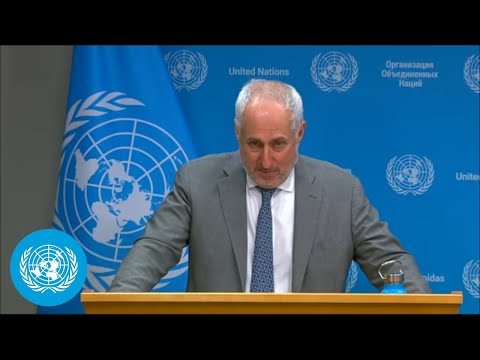
At a United Nations press briefing, the speaker, Stefan (staff member), summarized the latest security and humanitarian developments across multiple crises and answered journalists’ questions on UNIFIL monitoring, maritime access and human-rights concerns.
The briefing opened by announcing that representatives from the International Organization for Migration would speak about the launch of the World Migration Report. It then recounted sharp increases in exchanges of fire in southern Lebanon: UNIFIL recorded what the speaker described as the highest number of exchanges since April 17, including 619 launches by the Israeli Defense Forces impacting in Lebanon and 30 launches toward Israeli targets. The speaker said peacekeepers observed Israeli airstrikes, helicopter engagements and two weaponized drones over Sector West, and urged "all sides to exercise maximum restraint." The speaker also cited Security Council Resolution 1701 when calling for parties to fulfill obligations under that mandate.
The briefing included operational humanitarian details: UNIFIL distributed over 360 dry food parcels to displaced families from Fardounin municipality and supported a convoy of about 30 trucks to Er Meish carrying essential goods purchased in Beirut. Since March 2, UN food-security partners reported delivering more than 7.8 million hot and cold meals, over 105,000 meal boxes, roughly 3.8 million liters of bottled water, 64,000 cubic meters of trucked water and nearly 740,000 liters of fuel to sustain water services for more than 628,000 people. The speaker said cash assistance remains critical, noting more than 435,000 Lebanese people have been supported through a government-led social safety net with the World Food Programme and partners, and that over 100,000 Syrian refugees in Lebanon have been reached through expanded cash programs.
The briefing also covered Gaza, where the Office for the Coordination of Humanitarian Affairs warned of one of the highest weekly tallies of security incidents since last October, with humanitarian facilities coming under fire and an airstrike reported near a UN warehouse. The speaker emphasized that restrictions on entry of engine-oil spare parts, rubble-removal machinery and other items are "severely hindering" restoration of critical services, including generators and hospital intensive-care units.
On the Gulf and maritime safety, the speaker said multiple missiles and drones launched at the United Arab Emirates on May 4 caused injuries and damage at an oil facility in Fujairah and that recent strikes targeting vessels near the Strait of Hormuz "significantly raise the danger of renewed hostilities." He described Secretary-General-led efforts to explore mechanisms for safe passage of humanitarian goods through the strait and said Jorge Moreira da Silva (UNOPS) is working with the International Maritime Organization and other partners on options.
The briefing provided updates from other theaters: in Sudan, flights to and from Khartoum remained suspended after drone strikes on the airport; in the Democratic Republic of the Congo, negotiated access allowed the World Food Programme to resume distributions for more than 71,000 displaced people at the Plane Savo site in Ituri; peacekeepers escorted final-year secondary students to Bunia to sit state exams and rescued nearly 200 people reportedly caught under fire; and the High Commissioner for Human Rights signaled deep concern about coordinated attacks and civilian casualties in Mali and urged comprehensive investigations.
Notable exchanges during the question-and-answer session included: when asked whether UNIFIL’s strike counts include destruction of property, Stefan said UNIFIL monitors "what they're visibly monitoring in terms of fire" and is not in a position to tabulate all resulting damage. Asked whether a humanitarian corridor through the Strait of Hormuz could be established, he said the Secretary-General has tasked senior officials to work with maritime and trade organizations to explore mechanisms but declined to comment on draft Security Council language on demining. When a journalist noted an Israeli court had extended the detention of two flotilla activists, Stefan said, "They should be released." On the future of UNIFIL, he said there is a proposal for a post-UNIFIL UN presence and that the Secretary-General will present options to the Security Council in June; any change would follow the Council’s decisions.
On human-rights concerns in Iran, in response to a question about the execution of Kurdish activist Nasser Bekzada, the speaker reiterated that the UN stands against the death penalty "especially when it is applied when people were just using their given rights of freedom of expression and freedom of assembly."
The briefing closed by asking attendees to remain for the International Organization for Migration guest who would speak next about the World Migration Report. The session then proceeded to the next presentation.