Get Full Government Meeting Transcripts, Videos, & Alerts Forever!
Get email alerts on the Land Development topic
No spam. Unsubscribe anytime.
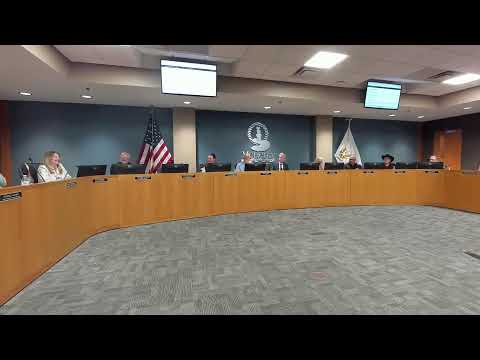
Developer presents 362‑home concept across from Oaks; council presses on density, parking and traffic
Summary
ADL & Associates proposed a 78‑acre concept for 161 single‑family lots and 201 townhomes across from the Oaks subdivision; council members raised concerns about townhouse density, one‑car garages, park ownership and whether IDOT will require a traffic signal.
Andrew Tegan of ADL & Associates presented a concept plan for a 78‑acre parcel across from the Oaks subdivision, proposing 161 single‑family lots and 201 townhomes — 362 units in total — along with four park sites, a detention basin and a bike‑path extension. He said much of the original infrastructure was stubbed during the project’s original buildout and estimated combined impact/connection fees “totaling up to 5.46 million” across taxing bodies if approved as contemplated.
Tegan said the team anticipates sales in a roughly 2027–2031 window, that many utilities are already stubbed across Veterans Parkway, and that the townhome product under consideration includes a 1,500 sq. ft. three‑bedroom model with a full basement and a single‑car garage. “That particular product … is something that they’ve done in some other markets and it’s gone really well,” Tegan said, adding that the full basement helps keep price points lower.
Council members questioned the plan’s density and circulation. Alden Benny asked about guest parking for three‑bedroom townhomes with one‑car garages, saying street parking and maneuvering could be problematic; Tegan replied that the one‑car garage was a trade‑off used elsewhere to reduce cost and that the team would consider parking mitigation. Alderman Miller said he “supports your concept with the exception of the one‑car garages,” calling a single bay obsolete in today’s market and urging more garage options for single‑family lots.
Several council members warned that the townhouse area felt too tight and could worsen congestion on Veterans Parkway and Route 31. A council member noted that IDOT (Illinois Department of Transportation) will assess signal warrants based on actual traffic counts rather than projected counts, and staff advised the council that a new signal at Veterans Parkway and Route 31 would likely require development‑level traffic to meet warrants. Council members said they would raise the issue in an upcoming meeting with IDOT.
Questions about parks and ownership surfaced repeatedly. Some council members and neighbors urged public parks rather than private HOA amenities, citing concerns about maintenance fees and access. Tegan said two of the four proposed park sites were envisioned as active parks with equipment and parking, while two would be passive open space; he said conveying maintenance responsibility to the HOA was straightforward from the developer’s perspective but that the city could direct otherwise.
Tegan also reported fiscal figures for the parcel: he said current EAV (equalized assessed value) is $48,553 and presented a projection that EAV would rise to approximately $42 million if the project proceeds. He said that, as presented, annual property tax revenue would rise “from approximately $3,700 per year to $3.5 million per year.” (The presenter’s stated tax figures appear disproportionate to the EAV change and may reflect a transcription or calculation ambiguity; the council asked staff to verify fiscal estimates before any approvals.)
Next steps: the developer said the team will take council feedback back to the landowner and return with refined concept or preliminary drawings and with staff‑requested clarifications such as home footprints on the 60‑foot lots, parking plans, and clearer park programming. Council members also asked staff to continue engagement with IDOT about signal warrants and to work with the developer on adjustments to lot widths and the location/character of parks.
Why it matters: the development would add hundreds of homes to a growth corridor, change local traffic patterns and raise substantial impact fees and tax base for local taxing districts. The council’s feedback will shape whether the concept proceeds through the city’s PUD and platting processes.