Get Full Government Meeting Transcripts, Videos, & Alerts Forever!
Get email alerts on the Urban Planning topic
No spam. Unsubscribe anytime.
Roswell consultants pitch targeted reinvestment in 14% of city while preserving single-family neighborhoods
Summary
City staff and consultants presented preliminary recommendations for a five-year update to Roswell's comprehensive growth plan, urging catalytic investment in commercial activity centers, describing a public review timeline and asking residents to weigh in via rotunda stations and a week-long online survey.
Consultants leading the City of Roswell's five-year comprehensive growth-plan update urged residents to focus investment on a small share of the city's commercial land to strengthen local jobs while preserving the character of single-family neighborhoods.
"My name is Michelle Alexander. I'm the director of community development here for the city," said Michelle Alexander as she opened the third community event on the update. She introduced the consultant team from Kimley Horn and KB U Advisory Group and turned the presentation over to Eric Brosman, the team's lead.
Brosman told the audience the update centers on roughly 14% of Roswell's land that is commercial, not to rezone neighborhoods but to identify "key catalytic properties" where reinvestment could grow the city's employment base. "This 5-year update to the comprehensive plan is the 14% of the city of Roswell that is your commercial area," he said, framing the effort as a 20-year vision that guides policy rather than immediate zoning changes.
Why target a small portion of the city? Brosman cited regional demographic and market trends: an aging population, declining school enrollment across Fulton County, and rising housing costs that make it harder for younger families to afford Roswell's single-family stock. Those dynamics, he said, have left Roswell with a mismatch between where residents live and where jobs are located, with many commuters traveling to other Atlanta job centers each day.
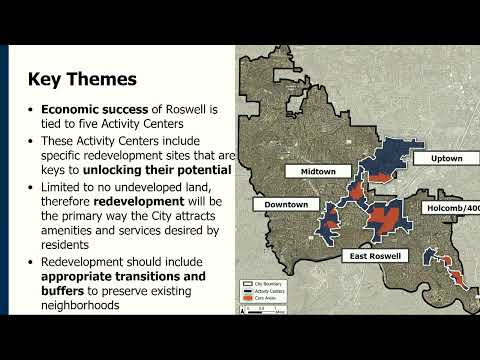
To address that, the consultants proposed concentrating reinvestment in a handful of activity centers rather than applying one strategy to the whole city. The team displayed a city map highlighting blue commercial areas and orange "focus" parcels they described as the best opportunities for catalytic change. The presentation emphasized transitions, green space and protections for adjacent residential areas.
Brosman also explained financing tools tied to those focus areas: the city's tax allocation district (TAD) boundary would capture incremental tax revenue from reinvestment and direct funds to infrastructure projects in targeted zones.
The meeting was structured as an open house with five stations for different commercial areas: the Georgia 400 corridor and its front-door gateway, downtown's walkable village core, the Highway 9/Mansell (uptown) employment area, East Roswell's neighborhood-serving centers, and the Midtown corridor with large aging shopping centers. Each station displays possible images, scales and public projects such as roadway improvements, parks and open-space investments.
Brosman said the public process has three phases: analyzing existing conditions, developing concept alternatives, and now drafting an action plan and short-term work program. He said staff and a stakeholder committee will review the draft before the city posts it for public review and forwards it to the Georgia Department of Community Affairs (DCA) and the Atlanta Regional Commission (ARC) for a roughly 30-day review. The team identified a target adoption timeframe of October to preserve the city's qualified local government status.
Community engagement remains active: Brosman said 275 people had completed the online survey as of that morning and that it would remain open for about another week; attendees were encouraged to use QR codes, postcards and comment cards at the stations to submit feedback.
The presentation concluded with an invitation for residents to speak one-on-one with staff at the stations and for the public to flag anything missing from the draft recommendations. Eric Brosman and other team members stayed to answer questions.
What happens next: the consultant team will incorporate feedback from the rotunda stations and the survey into a draft comprehensive growth plan, the city will review it with staff and the stakeholder committee, then publish the draft for public and agency comment before city council considers adoption.