Get Full Government Meeting Transcripts, Videos, & Alerts Forever!
Get email alerts on the Telecommunications topic
No spam. Unsubscribe anytime.
Putnam County board approves 265-foot cell tower after residents object to setback reduction
Summary
Putnam County’s Zoning Board of Adjustment approved a special use permit for a 265-foot communications tower on a 42.99‑acre agricultural parcel after staff recommended approval and the applicant cited wetlands constraints; the related variance seeking to reduce the 750‑foot setback was withdrawn by the applicant.
Putnam County’s Zoning Board of Adjustment on March 18 approved Special Use Permit SUP26-0000003 to allow a 265‑foot communications tower on a 42.99‑acre agricultural parcel along West River Road, after an extended staff presentation, applicant testimony and more than a dozen public comments both for and against the project.
Staff presented the proposal and recommended approval, concluding the application meets the county’s special‑use criteria and additional standards for cell towers under the land development code (references in the record to sections 45‑1083 and 45‑172). The staff report noted the parcel contains jurisdictional wetlands near the southwest corner, that the proposed tower would be sited in upland portion of the property, and that the nearest existing residence is about 912 feet from the proposed tower center. It also summarized required conditions including Development Review Committee (DRC) review, necessary county/state/federal licenses, and a dismantling financial assurance equal to 150% of the estimated removal cost prior to building permit issuance.
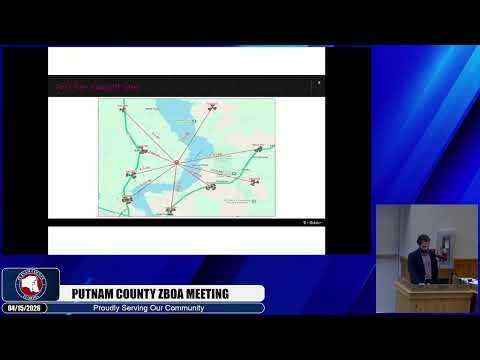
The applicant, represented by Darren Taylor of Holtzman Vogle and Joel Russo of Next Tower, said the site was selected after outreach to multiple landowners and a propagation analysis showing a gap in T‑Mobile coverage. “There is a need for improvement of cell phone service in this particular area,” Taylor told the board, adding the proposal avoids jurisdictional wetlands and would include vegetative buffering and a six‑foot security fence. Russo said the team completed a wetland delineation and a Phase‑I/NEPA review and that larger moves on the parcel would trigger Army Corps permitting and additional delays.
Residents who live near the site largely opposed the proposal and questioned staff maps, notice timing, property‑value impacts and public‑health concerns. “We are not anti‑cell tower. They need a cell tower out there, but it needs to be in the proper place,” said Kathleen Kelch, a trustee of a nearby land trust, who asked the board for more time to review the 138‑page staff packet and the site maps. Multiple speakers said the record lacked a certified appraisal showing no impact on property values; others raised concerns about visibility from riverfront homes and wildlife habitat.
One commenter raised electromagnetic‑field (EMF) health concerns and referenced studies they said supported a larger separation distance; applicant counsel responded that federal case law limits local governments from basing land‑use decisions on non‑land‑use health claims and that the board’s review must focus on land‑development code criteria.
Board members deliberated at length. An initial motion to deny resulted in a tie; after additional discussion the board ultimately voted to approve the special use permit with the conditions recommended by staff. The board record includes a reminder that applicants have a 30‑day window to appeal the board’s order to circuit court.
A related variance (V26‑00002) seeking to reduce the county’s standard 750‑foot setback from residentially zoned property to roughly 298 feet — a reduction the staff described as 451 feet and 6 inches — was introduced after the SUP hearing. Staff recommended approval of the variance because placing the tower farther inland would likely require impacting jurisdictional wetlands and because a 50‑foot fall radius and further DRC and building‑department review would address structural safety. Following additional public opposition, the applicant asked to withdraw the variance application to explore alternative siting and permitting options; staff confirmed the withdrawal and said the applicant may refile in the future.
What happens next: the SUP approval carries the six staff conditions, DRC review and permitting steps; the applicant must satisfy the financial‑assurance and easement conditions before a building permit will issue. The applicant and affected neighbors also have 30 days to seek judicial review of the board’s action.
Key technical and procedural details extracted from the record: the proposed tower is a self‑supporting lattice design about 265 feet tall with a certified 50‑foot fall radius; the parcel is 42.99 acres and the lease area is approximately 0.147 acres (6,400 square feet). Staff repeatedly noted that only a certified appraiser can provide expert opinion about property‑value impacts and that wetlands delineations, buffering and DRC requirements will be examined in the permit stage.
The record includes multiple references to county code sections governing special use permits and towers (45‑1083; 45‑72E; 45‑172); the applicant cited a propagation analysis indicating an absence of usable towers within a three‑to‑four‑mile search ring for the carrier. The variance application (V26‑00002) was withdrawn by the applicant and thus received no final board action.
The board’s decision to approve the special use permit came after extensive public comment and with explicit conditions; it does not eliminate subsequent permit‑stage technical review nor prevent a neighbor or applicant from pursuing an appeal or future reapplication on alternative siting.