Get Full Government Meeting Transcripts, Videos, & Alerts Forever!
Get email alerts on the Education Grants topic
No spam. Unsubscribe anytime.
Department of Education details Career Pathways Exploration grant: $44 million available; applications due June 9, 2026
Summary
The U.S. Department of Education on a technical‑assistance webinar outlined the Career Pathways Exploration (CPE) discretionary competition (Assistance Listing 84.424J): eligibility rules, two absolute priorities, scoring, reporting requirements, submission steps and an application deadline of June 9, 2026.
The U.S. Department of Education on a technical‑assistance webinar laid out the requirements and timeline for the Career Pathways Exploration (CPE) competitive grant, Assistance Listing 84.424J, intended to help states integrate career exploration into statewide career pathways and workforce readiness programs.
Yvonne Jaime, the CPE competition manager, said the program will provide competitive grants to states to expand career exploration for elementary and secondary students and to prioritize skills for high‑demand fields. "The assistance listing number for this opportunity is 84.424J," Jaime said, and applicants should consult the application notice (the "Annie") and the department's common instructions when preparing materials.
The department estimates $44,000,000 in available funds and expects to make between six and 15 awards. Jaime said the project period may be up to 36 months and the maximum award amount is $3,000,000 per year. She reiterated the application deadline: "Your application must be fully uploaded and received by the deadline of 11:59:59 p.m. Eastern time on 06/09/2026."
Eligible applicants are states as defined in Title 20 of the U.S. Code; governors may apply or may designate or endorse a single application per state from specified state entities such as state educational agencies, state workforce development agencies, state vocational rehabilitation agencies, or consortia of those entities. "Only one application per state is permitted," Jaime said, noting that applications submitted by entities other than the governor must include a signed governor's endorsement letter.
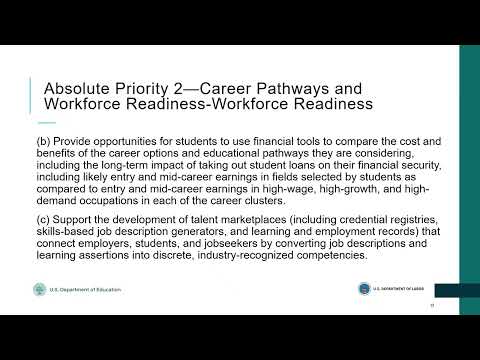
The notice identifies two absolute priorities applicants must address. Absolute Priority 1 focuses on career pathways and career exploration (for example, advising and exposure to postsecondary and career options). Absolute Priority 2 focuses on workforce readiness and includes four options applicants may pursue, including aligning workforce development with state priorities, promoting attainment of industry‑recognized credentials, supporting talent marketplaces and registries, and expanding registered apprenticeships (including educator apprenticeships).
A competitive preference priority tied to talent marketplaces and data infrastructure can earn up to three additional points, Jaime said; it centers on projects that strengthen career counseling, connect learning and employment records, and expand credential registries.
Selection criteria are broken into four factors: quality of project design (30 points), quality of the management plan (30 points), adequacy of resources (20 points) and quality of project evaluation (20 points). Jaime urged applicants to provide measurable, ambitious outcomes, a feasible management plan with appropriate personnel time commitments, a reasonable budget, and an evaluation plan that supports replication and continuous improvement.
Applicants must include project‑specific performance measures, baseline data and ambitious but achievable targets; grantees will report progress in annual and final performance reports. Jaime said applicants should explain any lack of established baseline data and describe how baselines will be developed during the project period.
Financial and administrative rules flagged in the webinar include a supplement‑not‑supplant requirement and a 10% cap on administrative costs. Jaime encouraged applicants to review their negotiated indirect cost rate agreements and to use their restricted indirect cost rate when budgeting.
On submission logistics, Jaime told applicants to register early with SAM and Grants.gov, provide the Unique Entity Identifier (UEI) used in SAM and Grants.gov, and allow 24–48 hours for SAM information to propagate to Grants.gov. File requirements include PDF read‑only files only (no fillable or password‑protected files), adherence to Grants.gov file naming rules, and a recommended narrative limit of 15 pages.
Jaime said applications will be screened for eligibility, externally peer reviewed, and applicants will be notified in writing or by email. The department anticipates making awards by Sept. 15, 2026. "If you have any follow‑up questions, please do not hesitate to contact me at careerpathways@ed.gov," Jaime said; she added the webinar materials will be posted on the CPE website.
The department emphasized civil‑rights compliance and that award terms and conditions will include post‑award compliance language. The announcement also specifies prohibited uses of funds (listed in the notice) and other program requirements tied to ESEA purposes.
The webinar provided detailed procedural guidance; applicants should rely on the official application notice and the common instructions for Department of Education discretionary grant programs for the full legal and technical requirements.