Get Full Government Meeting Transcripts, Videos, & Alerts Forever!
Get email alerts on the Education Grants topic
No spam. Unsubscribe anytime.
Education Department details FY2026 SEED grant: $90M pool, strict June 1 deadline and new priorities
Summary
The U.S. Department of Education outlined the FY2026 Supporting Effective Educator Development (SEED) competition on a pre-application webinar, describing $90 million in available awards, eligibility rules, four absolute priorities plus three competitive-preference priorities, strict submission deadlines and evidence requirements for cited studies.
The U.S. Department of Education held a pre-application webinar to review the FY2026 Supporting Effective Educator Development (SEED) discretionary competition, instructing prospective applicants on eligibility, priorities, evidence requirements and budget rules.
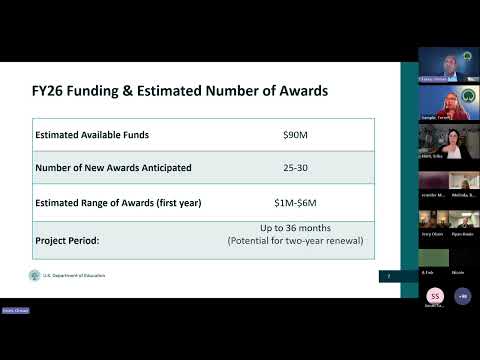
Orman Ferez, a SEED program official at the U.S. Department of Education, said the agency expects roughly $90 million in awards and "somewhere in the vicinity of 25 to 30 awards," depending on request amounts. He emphasized the project period is up to 36 months with a possible two‑year renewal after the initial project period ends.
The Department set firm procedural deadlines: intent-to-apply is strongly encouraged by May 1, 2026, and the application deadline is June 1, 2026, at 11:59:59 p.m. Eastern Time. "That is the absolute deadline. It cannot be June 2nd at 1200. One second late means it's late," Ferez said, reiterating that late submissions will not be accepted.
Applicants must be one of the eligible lead-entity types the agency listed: an institution of higher education (with demonstrated capacity), a national nonprofit entity, the Bureau of Indian Education, or an eligible partnership. Local education agencies (LEAs) may not serve as the lead applicant but commonly participate as sub-grantees or partners.
The competition requires responses to two absolute priorities and offers three optional competitive preference priorities (CPPs) that can add up to 20 points. Absolute Priority 1 focuses on supporting effective teachers (moderate evidence level); Absolute Priority 2 focuses on effective principals or school leaders (promising evidence level). Absolute Priorities 3 and 4 concentrate on evidence-based literacy and high-quality mathematics instruction, respectively. CPP1 ("returning education to the states") is a binary 0-or-10-point priority that hinges on endorsement by a governor or chief state school officer; CPP2 (advancing AI in education) and CPP3 (career pathways and workforce readiness) are worth up to five points each.
Melissa Harper‑Butler, who led the application‑parts overview, said the application is organized into six parts: standard forms (Part 1, including the SF‑424 and the required evidence form), budget information (Part 2, SF‑424A), a one-page abstract (Part 3), the project narrative (Part 4), budget narrative (Part 5) and attachments (Part 6). She stressed applicants must clearly indicate which absolute and competitive priorities they address and include supporting citations for evidence claims.
Terrell Sample described the selection criteria and scoring: quality of project design (40 points), quality of the management plan (25), quality of project evaluation and evidence building (25), and adequacy of resources (10), for a 100-point total; CPPs can raise the maximum to 120.
On evidence, staff said applicants must submit evidence forms tied to citations that are publicly available; the Department will conduct an evidence review for top-ranked applications in the funding range and will not recommend proposals whose cited studies fail to meet the required evidence level. "We will only recommend applications for funding that meet the evidence requirement for the program," staff said.
Budget guidance emphasized alignment of activities and costs and adherence to federal cost principles (allowability, allocability, reasonableness, necessity). Orman Ferez and colleagues urged applicants to provide personnel detail (positions, FTE, base salaries), to justify fringe rates (rule-of-thumb ~30%), to itemize travel and stipends, and to avoid budgeting for meals. The program generally uses a restricted indirect cost rate, with an 8% maximum noted as typical.
The presenters answered many attendee questions during a lengthy Q&A, including whether applications are scored in “buckets” (staff said that was unlikely this year), how different study designs (RCTs versus QEDs) factor into evidence reviews (no intent to systematically disadvantage particular study designs), how CPP1 endorsements should be provided (staff indicated a governor's endorsement letter is acceptable but said they would clarify parameters in follow-up guidance), and whether for-profit organizations can participate (for-profits may partner but cannot always be the lead applicant; lead applicant must be an eligible entity type listed in the notice).
The Department committed to post the recording, slide deck, corrections to the notice (the application notice instructions/"Annie"), and a missing application checklist on the competition webpage within 24–48 hours. Staff directed technical submission questions to Grants.gov and reminded applicants to confirm a Grants.gov validation receipt and to maintain an active SAM.gov registration.
The Department urged applicants to contact seed@ed.gov for substantive clarifications and said it will publish written follow-up responses to common questions on the competition webpage. The agency expects to announce awards on or before Sept. 30, 2026.