Get Full Government Meeting Transcripts, Videos, & Alerts Forever!
Get email alerts on the Comprehensive Plan topic
No spam. Unsubscribe anytime.
Dodge County Board adopts 2045 comprehensive plan after public hearing and clerical corrections
Summary
After a presentation and public comment, the Dodge County Board of Supervisors voted unanimously to adopt the Dodge County 2045 Comprehensive Plan, moving a small number of mapping corrections and leaving a process for future amendments and intergovernmental resolution with Watertown and Emmett.
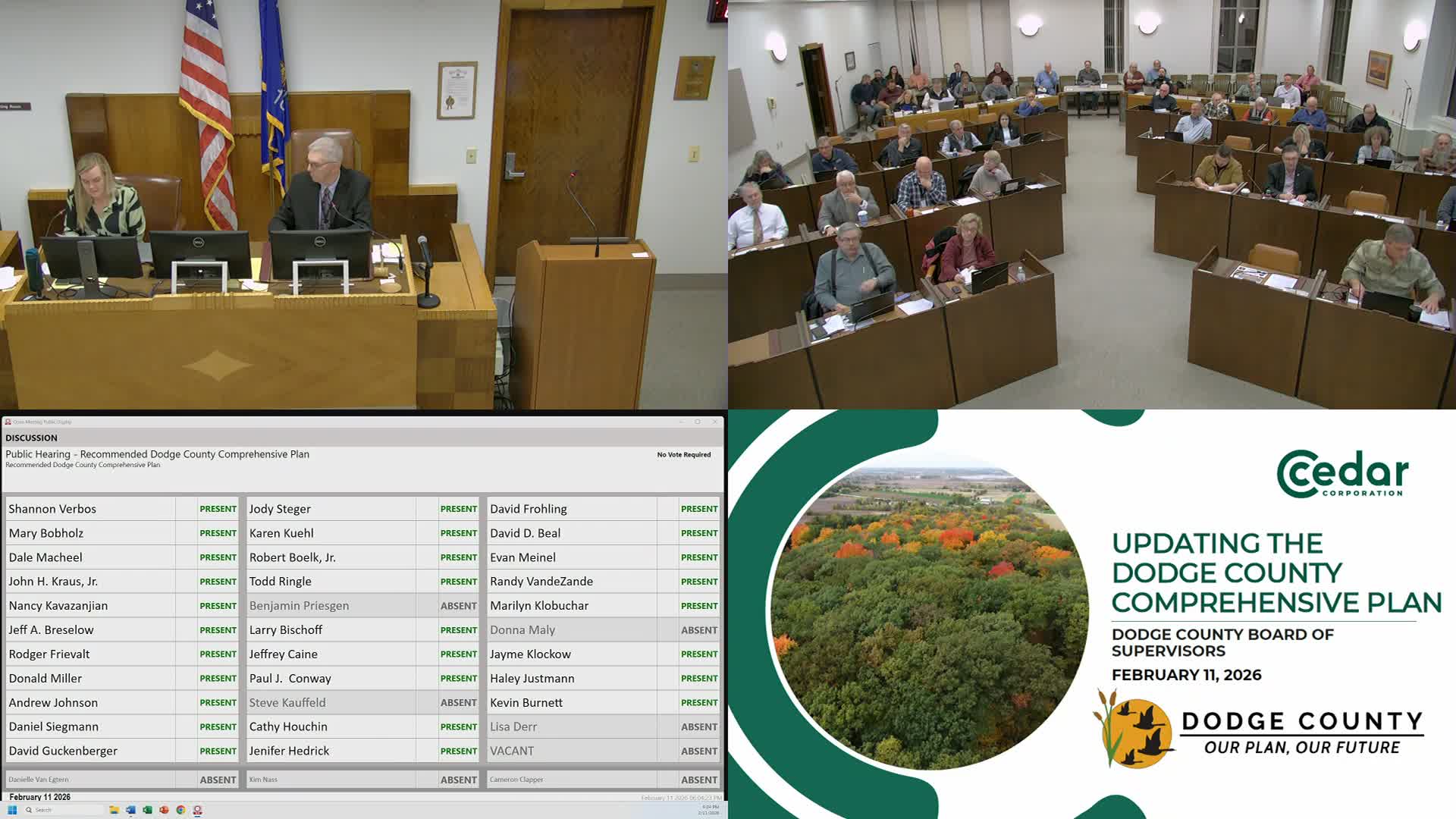
The Dodge County Board of Supervisors voted unanimously on the evening of Feb. 17, 2026, to adopt the Dodge County 2045 Comprehensive Plan, approving Ordinance 1188 after a staff presentation, public comment and limited map corrections.
The plan, presented by Nate Olsen, community development administrator for the county’s Land Resources and Parks Department, and Ken Jaworski of consultant Cedar Corp, packages nine statutory elements into more than 100 prioritized recommendations and a future land use map for the county’s unincorporated areas. Jaworski told the board the update followed substantial outreach: “a web-based project hub got about 9,500 views,” plus surveys and working-group meetings that produced hundreds of hours of review and 367 resident survey responses.
Why it matters: the comprehensive plan serves as the statutory basis for county zoning decisions and frames long-term priorities — from farmland preservation and trails to utility-scale solar and data-center considerations — that will guide amendments, permitting and multiyear budgeting.
During the public hearing the clerk read an email from Jane Parpart that flagged several clerical and mapping issues, including an incorrect provider name on Map 5.1 and a parcel shown as commercial on Map 8-2 that is zoned industrial. The letter also raised a safety concern about the potential reclassification of County Trunk TT after a bridge placement. The clerk read: “Turning TT into a non through road would no longer serve as a collector, but an entrance for Dodge County Park.” Staff pledged to correct the cited references and treat the TT item as a discussion of potential solutions rather than a formal recommendation.
Jaworski highlighted plan policies intended to protect productive farmland and natural features such as the Niagara Escarpment and Horicon Marsh. He said the plan includes a specific policy that "any proposed system over 50 megawatts must have a dual use component," intended to encourage agrivoltaic or similar practices on large solar projects.
Board members asked how the county will track the plan’s recommendations. Jaworski and Olsen said the planning department is the logical owner of monitoring and recommended periodic audits of progress; significant changes proposed after adoption would require referral to committees and, for material amendments, another public hearing. On a noted intergovernmental mismatch in the Emmett–Watertown fringe area, staff recommended the two local governments meet to reconcile their respective maps and, if needed, propose a joint amendment to the county plan.
The board approved a narrowly focused amendment changing one parcel’s future land use designation in Portland after the landowner and the town alerted supervisors to an apparent oversight. With that amendment the ordinance was adopted 28–0.
Next steps: staff will correct the clerical references identified during the hearing and the county will allow routine amendments (twice annually) or accept a formal future-land-use amendment if Emmett and Watertown submit a joint proposal.