Get Full Government Meeting Transcripts, Videos, & Alerts Forever!
Get email alerts on the Cip Financing topic
No spam. Unsubscribe anytime.
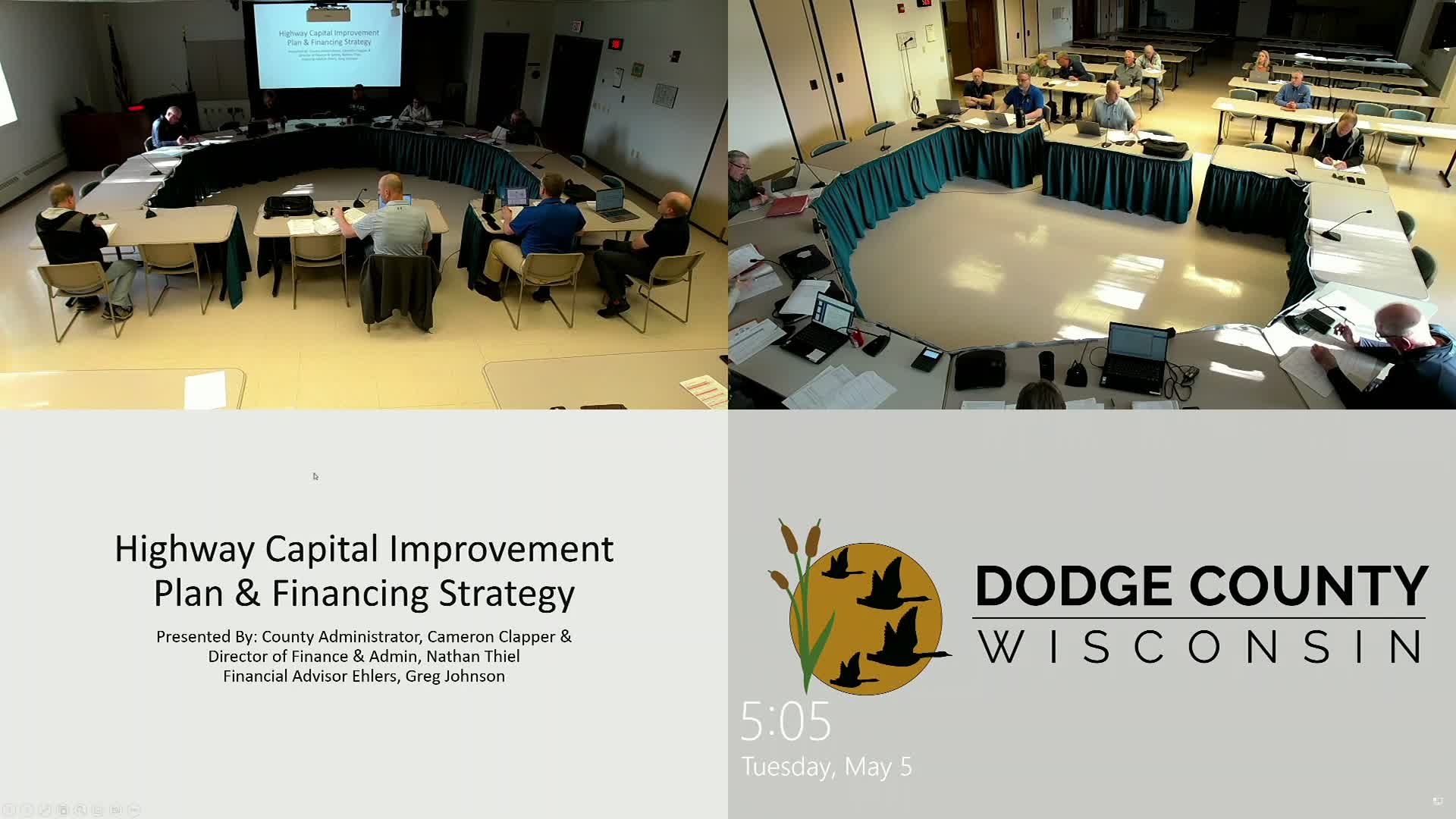
Dodge County committee hears highway financing options and advisor recommends hybrid approach
Summary
County staff and financial advisors outlined three financing models for highway and related capital projects, showing a tax‑rate range roughly between $0.23 and $0.33 per $1,000 for road debt alone; advisors recommended a hybrid model as a moderate, politically palatable option.
County staff and their financial adviser presented three options for financing a multi‑year highway capital improvement program and related tower and facility projects, with a recommendation for a middle‑path “hybrid” approach.
The presentation described three trajectories: an unconstrained program, a proactive program and a hybrid. The unconstrained model would fund a large, continuing reconstruction program and was modeled as about $53 million of debt for roads in the planning window; staff said that approach would average roughly $0.23 per $1,000 in levy impact for road debt. The proactive model, which accelerates reconstruction and adds a larger maintenance program, was modeled at about $80.7 million and an average levy impact near $0.33 per $1,000. The hybrid option modeled about $67 million and an average levy impact near $0.26 per $1,000 for roads alone.
Financial adviser Greg (surname not stated) said the three models use the same basic assumptions about sales‑tax contributions and a conservative equalized‑value growth assumption (50% of a five‑year average) and a 3% inflation assumption. He cautioned that models vary with assumptions and noted the figures could change if inflation or valuations shift. “If I were to make a recommendation, I really think the hybrid approach has some strong arguments that you could make politically from a standpoint of that it’s a 50/50 split with the sales tax,” the adviser said, recommending the hybrid as a balanced trajectory that provides room for course corrections.
Committee members pressed staff and the advisers on specific assumptions and timing. Staff said the models assume alternating debt issuances from 2027 through 2035 with levy impacts smoothed year‑to‑year. They noted combining the road program with two other capital items (tower upgrades and facility improvements) increases the combined tax‑rate range; staff presented a combined range of about $0.58 to $0.78 per $1,000 depending on whether high‑end facility and radio projects were included.
Members and members of the public raised concerns about cumulative tax impacts, with a Beaver Dam resident warning the board to be “cognizant of what’s going on in the surrounding area” and the possibility of overlapping levies creating pressure on townships and districts. Staff said the financing plan is a trajectory, not a lock‑step commitment: each debt issuance would need separate authorization by the board.
The advisers and staff outlined operational tradeoffs: the unconstrained option would require ongoing new issuances beyond the modeled window to sustain a high level of reconstruction; the proactive or hybrid paths aim to reach a maintenance level the county could sustain in budget thereafter. Staff recommended additional, more detailed budget and schedule work before formal board action and said the committee will review refined numbers from upcoming joint meetings on facilities and radio projects before taking a final financing vote.
Next steps: staff said they will deliver packet materials and refined numbers to the joint meetings this week, and the committee expects to revisit the models and consider precise wording for any initial resolution at a future meeting. The committee did not take a final financing vote at this meeting.