Get Full Government Meeting Transcripts, Videos, & Alerts Forever!
Get email alerts on the Solar Development topic
No spam. Unsubscribe anytime.
Dodge County committee tables 5 MW solar permit after hours of opposition from Ashpen residents
Summary
The Dodge County Land Resources and Parks Committee heard extensive public opposition to a proposed 5 MW solar facility in the Town of Ashpen, including concerns about property values, decommissioning funds and local emergency response; the committee voted to table the conditional use permit decision to April 13 to allow further review and conditions.
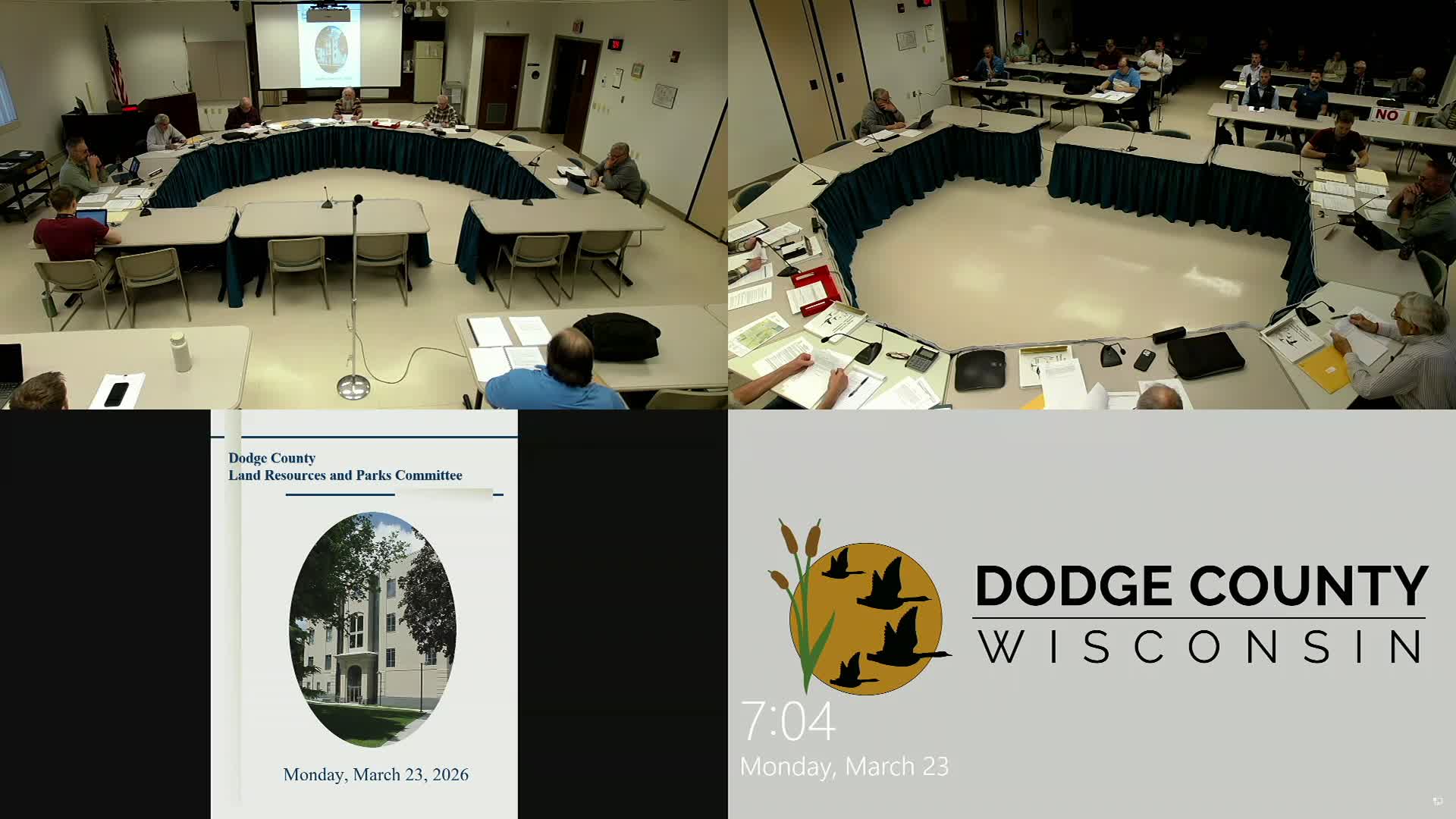
The Dodge County Land Resources and Parks Committee on March 23 heard hours of public comment before voting to table a decision on a conditional use permit for a proposed 5-megawatt solar facility in the Town of Ashpen.
Chair Dan Sigman opened the public hearing and staff read a report outlining the project: a 25-acre facility footprint (23 acres inside a fenced compound) on a 62-acre parcel in A1 prime agricultural zoning, 38 rows of ground-mounted panels, an access road and interconnection poles. Staff said the applicant submitted a decommissioning plan and estimated a 35-year useful life, and identified typical permit conditions (noise and lighting limits, erosion controls, signed decommissioning agreements and permit-duration limits).
Applicant Jacob Van Domelen presented site details, saying panels would be 8–10 feet on racking, no external lighting was planned, and a native-seed vegetative plan including pollinator habitat would be used. Van Domelen said the developer planned financial assurance so the county could draw funds to remove equipment if the owner failed to decommission the site.
Nearly all public commenters opposed the proposal. Dave Guchenberger, a Town of Ashpen planning commissioner, said the town recommended denial and argued the site was intended for future residential growth; he presented studies and a spreadsheet estimating potential losses in adjacent property values. “The proposed use does not seem to accomplish” the A1 district’s purpose of protecting farmland, he said.
Other residents raised environmental and safety concerns: Linda Jones said she had not seen a project return land to productive farmland after removal and worried about invasive plants, road damage from construction traffic and long-term county costs. Angela Papito warned of fire risk, chemical runoff and restricted wildlife movement from perimeter fencing; a separate commenter cited studies she said showed local property-value declines of 1.5–4% and questioned SunVest’s reported recycling values and the adequacy of decommissioning cost estimates.
Town and local officials asked for conditions if the committee approved the permit. One Town of Ashpen representative handed the committee a list requesting emergency-response training within 30 days of operation, annual updates to emergency plans, a 24/7 local contact for dispatch, anti-reflective coatings to reduce glare, limits on mechanical noise and a minimum 500-foot setback from residences, and asked that developers place decommissioning escrow funds accessible to the town.
Committee members pressed the applicant on screening and grading. The applicant said no large-scale grading was planned and that piles would be driven for racking; he said screening (berms or plantings) could be added and that soil testing and monitoring could be included in a decommissioning or compliance plan if the committee requested it.
Given the volume of public material submitted at the hearing and town opposition, Chair Sigman moved to table the conditional use permit decision to the committee’s April 13 meeting to allow additional review and to give staff time to craft potential conditions; the motion was seconded and approved by voice vote.
The record includes staff references to Dodge County Land Use Code provisions (section 2.36 and related subsections) and state statutes cited in the staff report as governing utility and conditional uses in A1 zoning. Staff noted erosion-control standards and potential stormwater calculations would be required prior to issuance of land-use permits.
Next steps: the committee will review the submitted materials and consider conditions at the April 13 meeting; no final vote on the conditional use permit was taken on March 23.