Get Full Government Meeting Transcripts, Videos, & Alerts Forever!
Get email alerts on the Land Use Solar topic
No spam. Unsubscribe anytime.
Dodge County committee denies conditional-use permit for proposed 5-MW Ashpen solar farm
Summary
The Dodge County Land Resources and Parks Committee denied a conditional use permit for a proposed 5-megawatt solar facility in the Town of Ashpen, citing the county land-use code finding that the project would cause a measurable decrease in neighboring property values (section 236F4). The denial was carried after members weighed agrivoltaics, public-safety and decommissioning concerns.
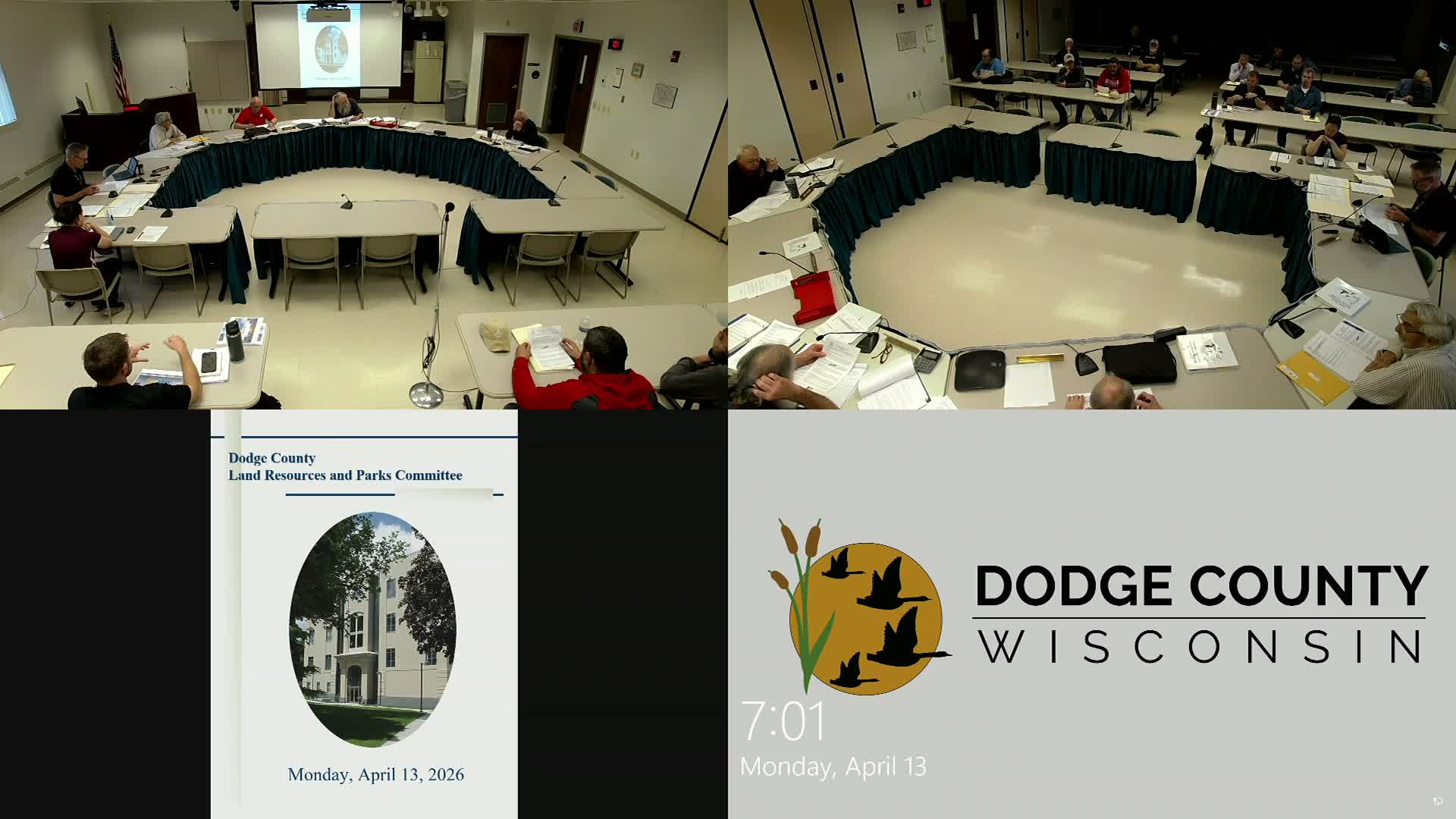
The Dodge County Land Resources and Parks Committee voted on April 13 to deny a conditional use permit for a proposed 5-megawatt solar facility on A-1 prime agricultural land in the Town of Ashpen. The committee cited its finding that the project would cause a substantial, measurable decrease in the value of neighboring property under section 236F4 of the Dodge County land use code.
Chair (Speaker 1) opened deliberations by summarizing the evidence presented at the prior public hearing and during tonight’s record review, saying the committee had “substantial evidence” that neighboring housing values could fall and that the code requires a finding on that point. The Chair added that mitigation options — including agrivoltaics (dual use of land for both farming and solar) and design changes — had been discussed but that the committee did not find them sufficient to meet the code’s requirement.
Staff reminded the committee that state law constrains the scope of local restrictions on solar and wind energy systems, read from the staff report and cited Wisconsin statute language limiting permissible local restrictions to those that (a) preserve public health or safety, (b) do not significantly increase system cost or reduce efficiency, or (c) allow reasonable alternative systems. The committee recorded that state statute reduces how the county may lawfully regulate siting, but that the local code’s 236F4 standard — a measurable decrease in neighboring property value — still had to be answered in the record.
Committee members also debated public-safety issues tied to battery storage and emergency response. A fire-service representative explained typical local fire-department response protocols for solar-facility incidents, and the applicant described proposed training and emergency plans. The committee pressed for clarity on decommissioning costs after conflicting evidence in the record: an applicant-submitted decommissioning estimate showing a modest net salvage (~$3,113) and separate evidence suggesting significantly higher net costs (on the order of $300,000).
After deliberation, the Chair moved to deny the conditional use permit “based upon the previously mentioned findings and conditions.” The motion was seconded; the committee carried the motion by voice vote and ordered the denial documented in the record. The Chair read the committee’s conclusion into the record: the proposal did not meet the approval criteria of section 236F of the county land use code and specifically failed to satisfy 236F4. Staff advised the applicant of appeal rights and the 30-day appeal period.
What happens next: the written denial and findings will be mailed to the applicant and owner; the applicant may appeal the committee’s decision under the process described in the staff report.