Get Full Government Meeting Transcripts, Videos, & Alerts Forever!
Get email alerts on the Municipal Budget topic
No spam. Unsubscribe anytime.
Council hearing spotlights proposed FY27 cuts to equity offices as community groups warn of immediate harm
Summary
At a May 12 Ways & Means hearing, city equity and inclusion offices described services and pilots while councilors and dozens of public speakers pressed to restore steep proposed cuts to community grants and contracted services that support immigrant, language-access, disability and LGBTQ programs.
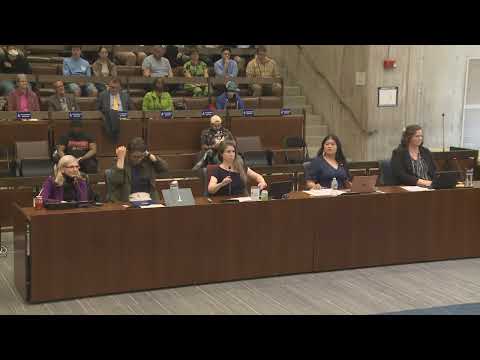
Boston City Council Committee on Ways & Means Chair Ben Weber opened a May 12 hearing on FY2027 budgets for equity and inclusion offices and invited panelists from the mayor's cabinet to present program results and explain proposed changes.
Courtney White, interim director of the Mayor's Office for Immigrant Advancement, told the committee her office recently completed a community survey of "744 immigrant and refugee Bostonians" and highlighted programs that included citizenship assistance and a summer youth initiative projected to serve about 500 young people across 33 partner sites. "We've provided 797 individuals with free immigration consultations" and the office said participatory budgeting added $400,000 for youth and people at heightened risk of detention and deportation.
Jennifer Vivera Wong, director of the Office of Language and Communication Access, presented data showing the city has spent "over $741,000 on fulfilling accommodations" this fiscal year and described pilots of TranslateLive devices and a central contracting model that funds on-demand interpretation for departments.
Kristin McCosh, the city's disability commissioner and ADA Title II coordinator, outlined the commission's internal compliance, training and architectural-review work and described a forthcoming dynamic ADA transition web tool intended to replace the city's static 1993 plan.
Julianne Lee, executive director of the mayor's office of LGBTQIA2S+ advancement (MOLA), summarized FY26 grant awards and partner networks, saying MOLA awarded "$275,000 in Beyond Pride grants" and ran an idea fund that distributed $70,000 for identity-document assistance. She warned demand for gender-affirming and well-being services remains high.
Councilors used the first round of questioning to press the administration about staffing, how services are funded, and how cuts will be backfilled. Panelists repeatedly said they were trying to protect core operations while identifying alternative revenue and partnership paths: LCA described centrally funded interpretation contracts; MOIA said it would preserve free immigration consultations and pursue partner funding; MOLA said it would prioritize remaining funds and seek external funders.
MOLA and other presenters confirmed significant reductions in community grant lines under the proposed budget. "Our grants were cut a 100%," MOLA's director said, and later described that contracted services, which include grants and community programming, were cut by 87% in the recommended FY27 plan. Committee members and some councilors highlighted large cuts across equity offices during the hearing and warned of concrete service losses to community partners.
Dozens of nonprofit leaders, program staff and residents then delivered public testimony. Tanya Neslussen of Mass Equality said, "If these budget cuts move forward and the community grant funding is eliminated, the consequences will be immediate and harmful." Trey Andre Valentine of the Massachusetts Transgender Political Coalition told councilors, "A sanctuary city cannot exist in name only," urging restoration of community grants. English for New Bostonians and other groups pressed the council to preserve ESOL parent classes and other neighborhood programs.
Panelists proposed several mitigation strategies: reallocating limited city funds, expanding partnerships with the Boston Public Health Commission and Boston Public Schools, tapping participatory budgeting and philanthropy, and keeping a subset of core services in-house where legally possible. They also flagged operational tradeoffs: maintaining personnel and essential citywide contracts while reducing flexible grant lines that community organizations rely on.
Chair Weber closed by reminding the room the council has an amendment window before final budget approval in June and noted the broader revenue constraints the city faces under Proposition 2—.
The hearing did not include any final votes; councilors said they will consider amendments to restore some grant funding before the budget is adopted.