Get Full Government Meeting Transcripts, Videos, & Alerts Forever!
Get email alerts on the Appellate Procedure topic
No spam. Unsubscribe anytime.
Utah Supreme Court hears argument on whether postconviction petitions are 'quasi‑criminal' for appellate rule purposes
Summary
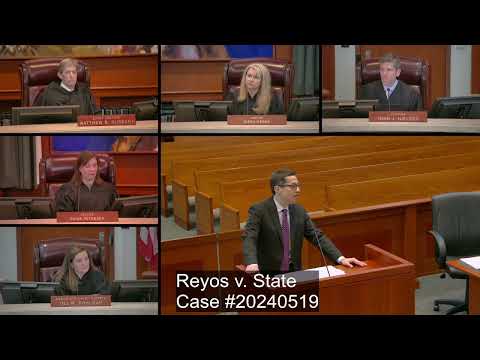
At oral argument in Ryos v. State, counsel for the petitioner urged that postconviction proceedings should be treated as "quasi‑criminal," meaning appellate rule 4F (with its flexibility) should apply to motions to reinstate appeals; the state countered that the issue was waived and that habeas/postconviction proceedings have historically been treated as civil.
Benjamin Miller, counsel for petitioner Frank Ryos, told the Utah Supreme Court that postconviction proceedings are "quasi criminal" because they directly challenge a criminal conviction and therefore should be governed by appellate rule 4F rather than rule 4G. "Postconviction literally, I mean, the word conviction is in the title," Miller said, arguing that the more flexible 4F standard is necessary to avoid denying relief to defendants who received incorrect advice from counsel.
Miller asked the court to reverse the district court’s denial of a motion to reinstate an appeal and to remand for factfinding or a hearing. He said applying rule 4G’s stricter deadlines could leave a petitioner without a remedy even where counsel and courts provided wrong information about available relief, urging the court to adopt a constitutional‑avoidance construction that would permit 4F principles to apply to postconviction motions.
Michael Gad, appearing for the state, urged the court to affirm. Gad said Ryos abandoned the preserved issue on appeal by advancing new remedies and legal theories that were not raised below. He also urged fidelity to longstanding precedent and legislative guidance treating habeas and modern postconviction petitions as civil: "For 118 years this court has labeled proceedings under the writ of habeas corpus as civil, not criminal," Gad told the justices and cited early Utah precedent to that effect.
The bench pressed both sides on preservation and on whether the distinction between civil and criminal labels should drive the outcome. One justice asked why the court should ‘‘affix a particular label’’ and whether the important question is what the rules imply rather than the label itself. Miller replied that while the court must place matters into procedural buckets, practice shows civil labels do not always dictate treatment — noting juvenile delinquency and other quasi‑criminal analogues where rules follow the criminal path. He invoked the court’s decisions in Patterson and Manning to argue for flexibility when strict time limits would produce injustice.
Gad countered with a historical and textual defense: he traced the civil characterization of habeas back to early cases (citing Winovich v. Emery and later decisions such as Julian), pointed to the modern postconviction rules (including rule 65C), and urged that Ryos had time and opportunity to raise alternative remedies in the district court rather than presenting new theories on appeal. Gad also said the record shows a 58A order was entered March 20, 2019, which started the appeal window and that the state had supplemented the record with federal pleadings. He added that a related federal motion to stay was filed but "never pursued."
The justices questioned whether the petitioner’s federal filings and the motion to stay showed he knew to return to state court to exhaust claims, and whether that undercuts the claim of being misled. Miller responded that the state did not contest merits below and that the record lacks findings about some of those federal filings, supporting his request for a remand to develop the record.
At several points the court probed preservation doctrine — whether the petitioner had preserved the precise 4F‑versus‑4G argument below — and whether this court may or should exercise discretion to consider the matter despite any preservation issues. The state argued the petitioner ‘‘waved’’ (waived) the critical argument on appeal by failing to press the same legal theory in the principal brief, while petitioner’s counsel said the district court had been presented with the core constitutional connection tying postconviction to habeas and that the Supreme Court may fairly resolve the question.
The argument referenced multiple precedents and doctrines (Manning, Patterson, Ralphs, Chadwick, Julian, and Stephenson were discussed) and focused on whether this court should apply appellate rule 4F’s restorative/flexible standards in postconviction appeals or allow rule 4G’s stricter timelines to control. Counsel reserved for rebuttal and the court took the matter under advisement.
Next steps: the court did not indicate a timeline for decision at argument, and the matter was taken under advisement.