Get Full Government Meeting Transcripts, Videos, & Alerts Forever!
Get email alerts on the Ordinance 445 topic
No spam. Unsubscribe anytime.
Clarkdale planning panel unanimously backs ordinance to shift many land-division and design-review approvals to staff
Summary
The Planning Commission voted Nov. 4 to recommend Town Council approve Ordinance No. 445, which amends zoning chapters 11 and 12 to conform with House Bill 2447 and ARS 9-500.49 by moving most site-plan, plat and design-review approvals to administrative staff under objective standards.
The Clarkdale Planning Commission voted unanimously on Nov. 4 to recommend that Town Council adopt Ordinance No. 445, a package of zoning-code amendments to chapters 11 (design review and site plan review) and 12 (subdivision regulations) intended to conform the town code with House Bill 2447 and Arizona Revised Statutes 9-500.49.
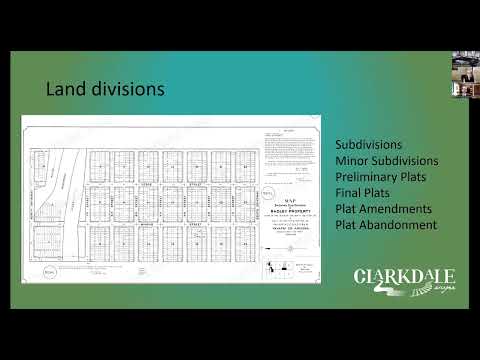
Ruth, a planning staff member presenting the amendments, told commissioners that the state law “reassigned the approval of land division to administrative staff rather than going through a public hearing and town council process and it also assigned administrative approval of design review to staff rather than going through any sort of public hearing as well.” The proposed ordinance enumerates the specific items affected — site plans, development plans, lot-line adjustments, lot ties, preliminary and final plats, plat amendments and plat abandonments — and replaces subjective design-review language with measurable standards, staff said.
Why it matters: The changes mean many routine technical approvals that previously required public hearings before the Planning Commission and final action by Town Council will now be processed by the community development director or designated staff if the application meets objective, written criteria. Appeals from staff denials would go to the Board of Adjustment, officials said.
Staff and the town attorney emphasized the limits and safeguards. Town Attorney Steven Pulk read the statute aloud and noted it requires municipal ordinances to authorize administrative review and approval of the listed items and to ensure design review is based on objective standards. “The legislative body . . . shall by ordinance . . . authorize administrative personnel to review and approve site plans, development plans, land divisions, lot line adjustments, lot ties, preliminary plats, final plats, and plat amendments without a public hearing,” Pulk said during his presentation.
What changes in practice: Staff gave examples of objective standards that could replace subjective phrases. The code will remove terms such as “compatible,” “appropriate,” “harmonious,” “congruent,” “consistent” and “compliment” and instead use measurable criteria — for instance, required window sizes, arch details, inlaid brick or defined roofline variations — that can be answered yes or no.
Public notice and recourse: Commissioners raised concerns about how the public will learn about projects that no longer go to a public hearing. Advisory Commissioner Carol Johnson asked, “how would the public ever know even though I know they're out of the picture,” and staff replied that the town will post applications and plans on a projects page on the town website, include items in weekly reports, use social media and notify local news outlets. Staff also said that rezoning requests and planned-area developments would still require public hearings.
Commissioner Marsha Marshia Fouts and others pressed how residents can influence technical details such as sidewalks on a site plan. Staff said staff-to-developer and staff-to-public meetings will continue and that staff frequently receives and responds to questions about posted plans, but that final-platted dimensions and engineering standards (for example, lot size and street widths) are less flexible than discretionary design processes.
The vote and next steps: A commissioner moved to approve Ordinance No. 445 and recommend adoption by Town Council; the motion was seconded and approved unanimously by voice vote. The commission forwarded the ordinance to Town Council with a recommendation for approval. The town attorney and staff said they are available to answer follow-up questions as the ordinance moves to council.
Background detail: The proposal also removes some policy wording from technical chapters, shifts certain procedural references from the Planning Commission to the community development director, clarifies post-approval financial assurances and inspection processes for infrastructure, and directs appeals related to design-review decisions to the Board of Adjustment.
The Planning Commission formally closed the public-comment period for the record (no public speakers had appeared) and adjourned the special meeting following the unanimous recommendation vote.