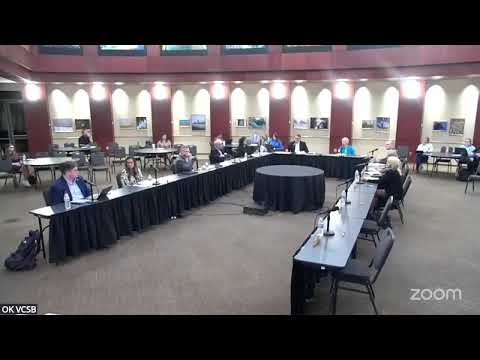
Board flags weak academic outcomes at two virtual charters and debates accountability weighting
Summary
The board reviewed 2023–24 performance frameworks for ESchool Virtual Charter Academy and Oklahoma Virtual Charter Academy, noting strong financial/organizational scores but low academic results and directing staff to research and propose rule changes to strengthen academic weighting.
The Statewide Virtual Charter School Board reviewed annual performance framework evaluations for two virtual charter schools and pressed staff on actions to address weak academic outcomes.
Dr. Smith presented the technical results for ESchool Virtual Charter Academy, noting that academic measures produced a low academic score (28%; 1.96 of 7 possible academic points), while the school's financial performance scored 100% and organizational performance was 94% with attendance below state average (73% vs. 78%). "Beginning with next year's performance framework, additional academic measures will be included to evaluate student academic growth," Dr. Smith said, noting staff plans to incorporate growth measures.
Staff then presented Oklahoma Virtual Charter Academy’s results: an academic composite near 41.9% (6.7 of 16 possible academic points), improvements in several grade bands and subgroup gains, but an overall graduation rate of 76% compared with the state’s 81%. Financial and organizational metrics were strong; the school received 96% on financial measures and 100% organizational points after addressing minor accreditation file and drill issues.
Board members repeatedly cautioned that strong financial and governance results should not obscure poor academic performance. "Strong compliance financials cannot mask the academic deficiencies," one member said, urging targeted academic improvement plans and measurable timetables. Several members argued the current framework’s weighting puts too little emphasis on academics and asked staff to research best practices and present proposed administrative rules for the August meeting.
Staff said they have already begun research into other states’ approaches and national guidance and will bring draft administrative rules and a recommended weighting model to the next meeting. The board directed staff to follow up with individual schools on improvement plans and to consider whether additional supports or corrective actions are needed.
AI generated
The text on this page is AI generated. Summaries, highlights, analysis, and video transcripts are all produced from the original source material.
AI can make mistakes, so if you spot one, and we will fix it for everyone.
Note: the source content is unaltered by us. Any content source we link to, be it a video, an audio recording, or a document, is presented exactly as its publisher released it. That publisher is usually a government body, sometimes an individual official or another organisation.