Get Full Government Meeting Transcripts, Videos, & Alerts Forever!
Get email alerts on the Transitional Housing topic
No spam. Unsubscribe anytime.
Planning commission approves two transitional residences on Washington Avenue for nonprofit operator
Summary
The commission unanimously approved special-use permits for two transitional residences at 915 and 921 Washington Ave to be operated by a nonprofit offering wraparound services; the applicant presented client success stories and said stays may run up to about 12 months on a case-by-case basis.
The Kalamazoo City Planning Commission voted April 8 to approve special-use permits allowing two existing residential properties — 915 and 921 Washington Avenue — to operate as transitional residences under the management of a nonprofit applicant.
City staff recommended approval after describing the properties’ zoning, site layout, parking and public-safety access. Staff noted both buildings already hold housing certifications and that the proposed uses meet the zoning decision criteria for compatibility with surrounding land uses and for minimizing adverse impacts.
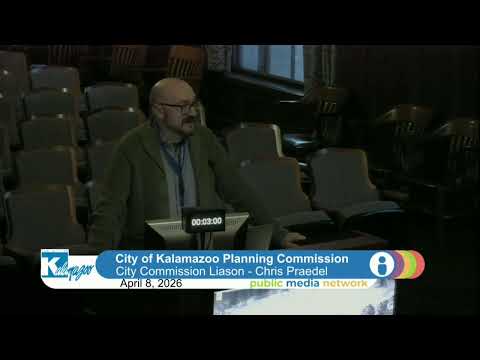
Applicant Gwendolyn, who identified herself as the organization’s CEO and a Northside resident, described the properties’ use as family-oriented transitional residences connected to county housing resources. She read a testimonial from a former resident, Alicia Johnson, who said, “While staying there, I was able to find a job, look for housing and also save money.” The applicant said program services include daily meals, laundry assistance, transportation to appointments and referrals to housing-choice vouchers.
Commissioners asked whether the label “transitional” carries an enforceable time limit. Staff said zoning definitions distinguish short-term rental categories (often tied to the 30-day threshold) but that approving a transitional-residence use does not itself set a strict maximum stay; the applicant said similar program sites have permitted stays up to 12 months on an individualized basis while the goal remains transition to permanent housing.
Staff reported one neighborhood voicemail opposing the requests but said the applicant carried out door-knocking outreach and an open house; one initial caller later expressed support after seeing operations. After brief discussion and positive comments about the nonprofit’s outreach and services, the commission approved both special-use permits by roll-call/voice votes.
The approvals direct the projects to proceed to the city’s site-review and housing-certification follow-up processes, and staff will monitor compliance with relevant zoning and public-safety standards.