Get Full Government Meeting Transcripts, Videos, & Alerts Forever!
Get email alerts on the Transportation topic
No spam. Unsubscribe anytime.
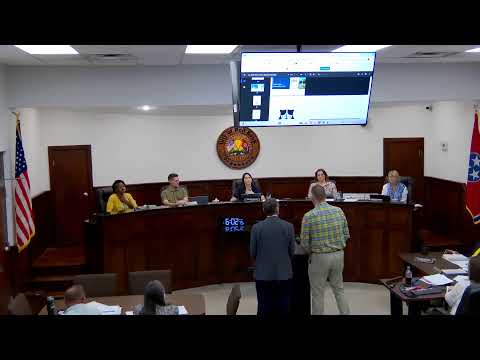
Red Bank moves on multiple traffic safety measures; speed‑camera pilot prompts privacy questions
Summary
Commissioners reviewed ordinances to lower speed limits on Dayton Boulevard and downtown corridors, formalize school zones for four schools and discussed a proposed two‑year agreement with Blue Line Solutions for automated speed enforcement; commissioners pressed staff on ALPR language, data retention and verification procedures.
Commissioners reviewed a package of traffic safety items: an ordinance to lower posted speeds on a portion of Dayton Boulevard, downtown speed limit changes tied to a planned downtown district, formalized school zones for Red Bank schools and Point Christian Academy, and a proposed agreement with Blue Line Solutions to pilot automated speed enforcement in school‑adjacent and S‑curve locations.
Director Tate described the Dayton Boulevard change as a speed reduction from 40 to 35 miles per hour along a roughly 0.93‑mile stretch beginning about 230 feet north of the Springer/Stringers Ridge tunnel and continuing to Hedgewood Drive. Tate said the change follows TDOT resurfacing and restriping that added dedicated bicycle lanes and narrowed vehicle lanes, and that law enforcement crash reports and DOT mobility studies recommended aligning posted speeds to the new roadway design.
On school zones, staff proposed formalized boundaries and posted speeds for Red Bank High School, Red Bank Middle School, Alpine Crest Elementary and the newly included Point Christian Academy, with school‑zone signage and hours to be posted and an education campaign to notify neighbors.
Staff also presented a proposed agreement with Blue Line Solutions to install automated speed‑enforcement cameras in targeted locations (Ashton Terrace and corridors near the high/middle schools). Staff described the operational flow: Blue Line would host captured violation images on its servers and a Blue Line employee would flag potential violations; a Red Bank officer must then log in to verify the vehicle, the speed violation and whether the school zone was active before a citation is issued. Staff emphasized the system records images only when the camera is triggered by a speed violation and that non‑matching plate data are purged.
Commissioners pressed staff about a draft contract exhibit that referenced automated license plate recognition (ALPR). Staff said the ALPR language was included in a template and was not intended to be enabled for the speed‑camera pilot; commissioners asked that any ALPR references be removed from the final contract language. Other concerns included signage and warnings (three staged warnings were described), bus exceptions and privacy/retention rules (staff said images are purged when a plate doesn't match a registration or when a non‑violation is recorded).
Why it matters: The combined package aims to make streets safer for drivers, cyclists and pedestrians and to reduce serious crashes; the Blue Line proposal raised privacy and operational questions commissioners asked staff to resolve before returning a final contract for approval.
Next steps: Staff will refine ordinance language where needed before final readings and will work with the city attorney to remove or clarify ALPR language and to define retention and audit controls in the Blue Line contract.