Get Full Government Meeting Transcripts, Videos, & Alerts Forever!
Get email alerts on the K 12 Education topic
No spam. Unsubscribe anytime.
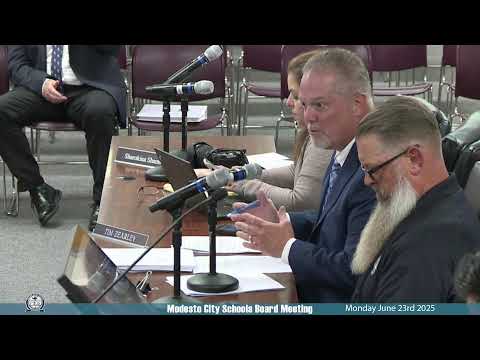
Modesto board approves Puberty Talk for fifth grade after heated public comment, allows selective opt‑outs and community partners
Summary
After more than three hours of public comment and extended trustee debate, the Modesto City Schools Board voted 5–2 to adopt the Puberty Talk fifth‑grade health curriculum for 2025–26, adding sheriff‑department or similar community lessons on human trafficking and internet safety and confirming parental selective opt‑out rights.
Modesto City Schools’ Board of Trustees voted 5–2 on June 23 to adopt the Puberty Talk health curriculum for fifth grade in the 2025–26 school year, adding a requirement that the district contract with the sheriff’s department or a similar community organization to provide lessons on human trafficking and internet safety. Trustees clarified that parents may opt their children out of any individual lesson in writing.
The decision followed a presentation by Mike Rich, the district’s associate superintendent for curriculum, who told the board the committee that reviewed materials met several times and voted 10–5 to recommend Puberty Talk. Rich summarized the legal framework, saying the California Healthy Youth Act (AB 329) requires instruction be medically accurate, age appropriate and inclusive where a district elects to teach CHYA topics in grades below seven; he also described the district’s notification and electronic opt‑out procedures.
The meeting featured a packed public‑comment period that ran for more than two hours and included sharply divided testimony. Opponents said the curriculum was sexualized and asked the board to postpone adoption, change to an opt‑in model, or limit lessons to basic hygiene and growth. “This material is not age appropriate for 10 year olds,” said retired teacher Ron Worsham. Supporters, including classroom teachers and health‑care professionals, argued early education protects children, improves reporting of abuse and strengthens school climate. “Comprehensive health education is protective,” said Dr. Nicole McLaren, a local family physician.
Board discussion focused on three issues raised repeatedly by speakers: the curriculum’s age‑appropriateness, language access and translation of materials, and the opt‑out process. Trustees asked staff to confirm that teacher‑facing materials contain more background detail than student‑facing slides and to provide parent‑facing materials in Spanish. Legal counsel’s guidance — relayed in the meeting — clarified that if the district teaches CHYA topics to any grade below seven it must include the CHYA components, and that parents can opt out in writing of gender‑identity instruction.
Trustee Marks proposed an alternative motion to adopt a narrower curriculum limited to hygiene and growth/development supplemented by community partners for topics like internet safety; that motion failed on a 5–2 vote. Trustee Lopez then moved to approve Puberty Talk with the addition of sheriff’s‑office or comparable contractor lessons on human trafficking and internet safety and with explicit selective opt‑outs available to parents; Vice President Mahia seconded. The motion passed 5–2 (Yes: Brown, Irvin, Lopez, Mahia, Mestas; No: Marks, Daly).
The board also heard and approved related district business later in the meeting: trustees adopted the district 2025–26 Local Control and Accountability Plan and certified the 2025–26 budget (each passed 6–1) after separate public hearings and staff presentations.
What the vote means: Puberty Talk will be available to fifth‑grade students beginning in 2025–26. The district will notify parents in advance and provide an electronic opt‑out form; parents may choose to opt out of specific lessons. Staff committed to posting student‑facing materials in parent‑facing formats online and to providing Spanish translations and community town halls to explain curriculum content. The superintendent and trustees said they will monitor opt‑out rates and report back if changes are needed.
The board’s full meeting packet and the adopted curriculum materials will be posted on the district website. The board scheduled a short recess after the vote and continued other agenda items, including public presentations not related to the item.
Sources: Board meeting presentation and public testimony at the Modesto City Schools regular board meeting, June 23, 2025. Quotes and factual points in this article are drawn from the meeting transcript and on‑the‑record remarks by district staff, trustees and public commenters.