Get Full Government Meeting Transcripts, Videos, & Alerts Forever!
Get email alerts on the School Finance Recalibration topic
No spam. Unsubscribe anytime.
District staff propose moving legacy reserves to seed self‑funded employee health plan as state recalibration changes reserve rules
Summary
At a work session, district finance staff outlined how a state "recalibration" law will change which reserves count toward new limits and proposed creating an internal service fund to operate a self‑funded employee health plan, seeding it with legacy pre‑1997 funds to stabilize cash flow and rates.
At a district work session staff told the board that state recalibration legislation will change how school reserves are counted and lower the district's reserve cap, and they proposed a set of structural changes to preserve services and cash flow.
Jed and district finance director Mr. Cell said the recalibration bill will leave the district operating under a 30% general fund reserve limit through fiscal year 2028, then reduce the allowable reserve by 10 percentage points to 20% for the fiscal year ending 2029. Mr. Cell said that while the district has historically not approached the 30% cap (the highest recent level was about 15.2%), the change shortens the transition timeline and creates compliance risk for legacy balances that have been carried forward since before 1997.
Why it matters: the law reclassifies some previously shielded local resources so they now count against reserve limits, restricts the use of foundation/block‑grant dollars for major building repairs or enhancements, and limits what revenue can flow into special reserve funds. Those changes could affect the district's ability to cash‑flow payroll, capital projects and insurance deductibles without explicit board action.
What staff recommended and why: Mr. Cell proposed establishing an employee internal service fund to operate a self‑funded health plan and to seed that fund by transferring the district's legacy pre‑1997 balance (about $4.1–4.2 million) into it. "The proposed action ... is that we would propose to move that legacy pre97 amount into the employee health internal service fund," Mr. Cell said. He told the board that seeding the fund would provide immediate cash for early July claims and help stabilize future rates: if the district does not use the full amount, it could offset future rate increases.
Mr. Cell described advantages of self‑funding: "we can do cost containment strategies, lower administrative costs, we can retain our investment earnings for our health insurance plan as a whole," and said the district's consultants and existing finance staff can operate the program without major new hires for the near term.
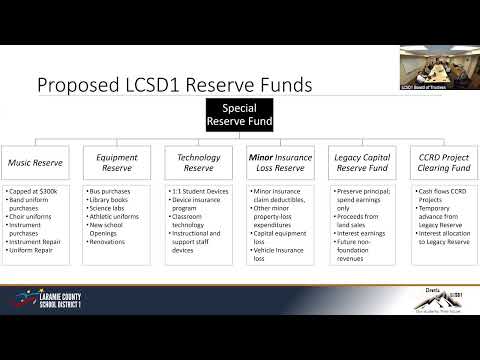
Other reserve changes discussed: staff recommended closing the legacy CTE reserve (current balance reported at $92,189; cap $125,000) because those legacy monies do not meet current grant compliance and would not count toward restricted grant purposes. Mr. Cell recommended transferring any remaining balance into the technology or equipment reserve.
Special building fund and restricted revenue: staff explained the special building fund is a long‑running, commingled account that historically received land sale proceeds, delinquent tax collections and other non‑block‑grant dollars. Because those proceeds stretch back decades, staff said it is difficult to separate foundation (block‑grant) dollars from other sources. Under the proposed restructure, proceeds from sales of pre‑1997 buildings or land would be treated as corpus in a preservation reserve and only interest earnings would be available for appropriation unless the board authorizes release.
Insurance and risk management: the district's insurance loss reserve (created several years ago) was highlighted as critical to responding to major hail and wind losses. Mr. Cell warned that the recalibration law's restrictions on using foundation dollars for capital work could constrain options for paying large insured losses, noting high deductibles and rising premiums. "The statement was 'you have insurance for that,'" Mr. Cell said, paraphrasing legislative guidance; he added that when insurance does not provide the recommended coverage, the district will need other solutions.
Timeline and next steps: staff listed near‑term actions they will bring to the board: formalize the transition to a self‑funded health plan (including setting up the internal service fund, stop‑loss insurance and third‑party administrator agreements), move the pre‑97 balance into the health fund via required budget amendments, close the CTE reserve and transfer its balance, and reauthorize the special reserve structure to align with the new law. Mr. Cell cautioned the board that the schedule is compressed because these changes intersect with upcoming budget development.
The board asked procedural questions about timing for budget approvals and operational impacts; staff said they are preparing approvals for stop‑loss insurance and other administrative elements and expect to return with formal action items in coming meetings. The work session concluded with the chair closing the meeting at about 5:40 p.m.