Get Full Government Meeting Transcripts, Videos, & Alerts Forever!
Get email alerts on the Automated Enforcement topic
No spam. Unsubscribe anytime.
Redbank commission authorizes automated speed-enforcement contract and approves related speed-limit changes after extended debate
Summary
After extended public discussion, the Redbank commission authorized staff to enter an agreement with Blue Line Solutions to deploy automated speed-enforcement cameras in school zones and dangerous curves, approved first readings of several speed-limit ordinances and laid out reporting and operational expectations, while residents raised concerns about hours, oversight and revenue use.
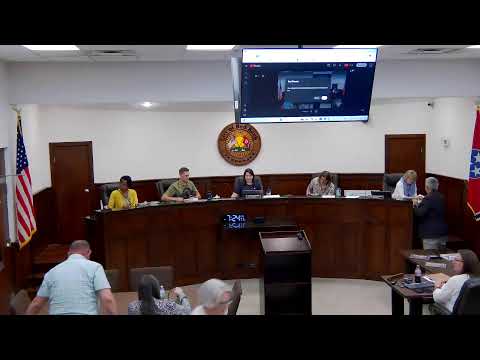
The Redbank Board of Commissioners on Monday authorized city staff to enter an agreement with Blue Line Solutions to install and operate automated speed-enforcement cameras in defined school zones and at several high-risk roadway sections after a long public discussion and unanimous vote.
Vice Mayor Barry introduced Resolution 26-1895, saying the technology is intended to slow traffic and reduce crashes in parts of the city that have shown a disproportionate share of severe injuries. "We want to save lives and we want people to slow down," Barry said during the discussion. City Manager Brandon and the police chief described a multistep rollout that would include site engineering, a public-education period and monthly data reporting to the commission.
The program will target legally permissible locations — notably school zones and the S-curves on National Terrace and other sections identified in traffic studies — and staff said they would set the exact hours and violation thresholds in the final contract. The police chief said the city intends an educational first month with warning notices before citations are issued and that the cameras can be configured to operate during school arrival and dismissal windows or run continuously where state law permits. "We want to make sure that everybody knows that the education is the most important part," the chief said.
Commissioners and residents pressed staff on several operational points: whether cameras would be limited to school-hours only or could operate 24/7 in certain hazardous segments, whether the commission would see the final contract before hardware installation, how long the city would be committed to a vendor, and how revenue would be handled. Staff said the agreement seeks authorization to contract (not approval of a single final specimen contract) and that the city manager or mayor would be authorized to sign the final documents after review by the city attorney; staff also said they would consult the commission about location, hours and thresholds during implementation planning. The vendor's initial deployment typically requires a two-year commitment, staff said, to amortize engineering and installation costs.
Residents voiced mixed reactions at the mic. One attendee from 211 Woodro Avenue said simply, "We're going to hate speed cameras," while others urged transparent reporting and recommended that any civil penalties be dedicated to street-safety initiatives. City staff said the revenue split discussed in the meeting is 50/50 with the vendor and that the city plans to publish periodic reports of violation and speed-reduction data.
The debate occurred alongside first readings and amendments to multiple ordinances that define the legal speed limits and school-zone parameters the cameras would enforce. Commissioners approved first readings to amend the FY26 operating budget to include a modest stormwater appropriation (Ordinance 26-1302), adjust captions and boundaries for state-route and local speed-limit language (Ordinance caption amendment and 26-1304), and define school-zone speed rules (Ordinance 26-1305). Staff and engineering studies were cited to justify a recommended 35 mph posted limit for parts of Ashlin Terrace rather than the previously posted 25 mph, with enforcement to target significant exceedances.
A final vote on Resolution 26-1895 carried in open session after the discussion, authorizing staff to enter the agreement and begin implementation steps. Staff committed to returning to the commission with rollout specifics and to provide ongoing monthly data on violations and speed reductions.
Votes at a glance: Resolution 26-1895 (Blue Line automated enforcement) — approved; Ordinance 26-1302 (FY26 budget amendment) — carried on first reading; Ordinance caption amendment (SR 8/Harvard boundaries) — carried on first reading; Ordinance 26-1304 (Ashlin Terrace/Dayton Blvd speed limits) — carried on first reading; Ordinance 26-1305 (school-zone speed parameters) — carried on first reading.
Next steps: staff will finalize contract language with the city attorney, coordinate with public works and police on siting and signage, begin an education/warning period once hardware is installed, and provide 30-day reports showing reduction metrics.