Get Full Government Meeting Transcripts, Videos, & Alerts Forever!
Get email alerts on the Industrial Safety Csb Investigation topic
No spam. Unsubscribe anytime.
CSB: Nov. 13, 2020 hydrogen chloride release at Voder Polysilicon was "completely preventable"
Summary
The U.S. Chemical Safety and Hazard Investigation Board found a Nov. 13, 2020 hydrogen chloride release at Voder Polysilicon in Charleston, Tenn., was caused by overtightened bolts, poor written procedures, lack of hazardous-energy controls, unmanaged simultaneous operations and inadequate means of egress, and recommended regulatory and industry actions.
The U.S. Chemical Safety and Hazard Investigation Board (CSB) released a report concluding that a Nov. 13, 2020 hydrogen chloride release at Voder Polysilicon in Charleston, Tennessee, was "completely preventable," after an overtightened bolt cracked a heat exchanger and produced a toxic cloud that contributed to one contractor's death and serious injuries to others.
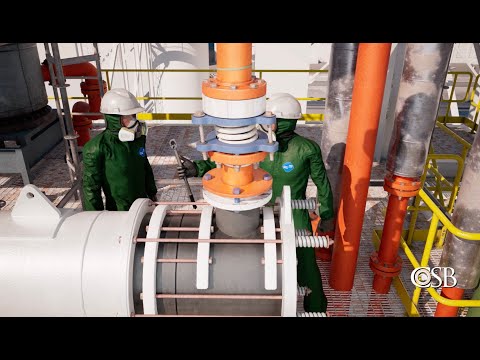
The CSB said the release occurred during a two-week turnaround on a hydrogen chloride regeneration unit. Contractors from multiple companies were on a fifth-floor equipment-access platform when a Jake Marshall pipefitter tightened bolts on a vapor-outlet heat exchanger using a torque wrench set to 40 ft-lb — the setting for steel-to-steel connections — even though the steel-to-graphite connections required approximately 15 ft-lb. The excess torque cracked the exchanger and released a dense hydrogen chloride cloud that, within seconds, obscured visibility and blocked the only available staircase.
The cloud exposed several workers. One apprentice pipefitter's chemical suit tore and his respirator was knocked off; three insulation workers from another contractor put on escape respirators but, lacking chemical suits, could not pass through the cloud and attempted to climb down piping about 70 feet high. Three fell; one was fatally injured and two sustained serious injuries. The hydrogen chloride release continued for about three minutes before dissipating, after which several workers evacuated via the staircase.
The CSB identified four key safety failures that contributed to the incident: the absence of written procedures for the specific torquing tasks; failure to apply hazardous-energy controls and to perform a risk analysis for torquing activities on equipment containing pressurized hazardous chemicals; lack of a formal simultaneous-operations ("simops") hazard-assessment program to evaluate collocated work; and insufficient means of egress from the elevated work platform despite earlier employee concerns and a prior Process Hazard Analysis that identified the need for an additional exit.
On written procedures, the CSB said the company relied on verbal instructions and an equipment manual that did not include the bolt torque values; the manufacturer's drawing containing the correct torque specifications was not available to the pipefitters on site. The report traces how the torque requirement was verbally relayed from the permit authorizer to the foreman to the journeyman and finally to an apprentice, increasing the likelihood of miscommunication.
Regarding hazardous-energy control, the CSB noted the company's procedures required energy-isolation planning when performing work that intentionally opened process equipment, but Voder did not apply those procedures to torquing tasks that could unintentionally open or damage fragile components, nor did it barricade the area to prevent non-essential personnel from being present.
The CSB also flagged a regulatory and guidance gap for simops in stationary chemical processing maintenance. The agency said industry guidance has largely focused on offshore operations and that it was unable to identify codes, standards or regulations specifically addressing simultaneous maintenance tasks on stationary chemical processes.
As a result, the CSB made multiple recommendations: that the Occupational Safety and Health Administration consider promulgating or modifying standards to require employers to coordinate simops involving multiple workgroups (including contractors); that the Center for Chemical Process Safety (CCPS) publish practical guidance on evaluating and managing simops; and that standards bodies including the International Code Council and the National Fire Protection Association amend codes to address multiple means of egress from elevated equipment platforms used to access equipment containing materials that pose physical or health hazards.
The CSB report includes technical details and recommended corrective actions intended to prevent similar tragedies, and directs readers to csb.gov for the full report and supporting materials. The agency said implementation of these recommendations is necessary to address the safety gaps it identified.