Get Full Government Meeting Transcripts, Videos, & Alerts Forever!
Get email alerts on the Industrial Safety topic
No spam. Unsubscribe anytime.
CSB: Preventable pump failures, missing monitors and valve gaps worsened 2019 ITC Deer Park tank fire
Summary
The U.S. Chemical Safety and Hazard Investigation Board says mechanical failures, absent flammable-gas detection and lack of remotely operated isolation valves allowed a March 2019 pump leak at ITC Deer Park to ignite and spread to 14 tanks; the CSB recommends industry and federal rule changes to reduce future risk.
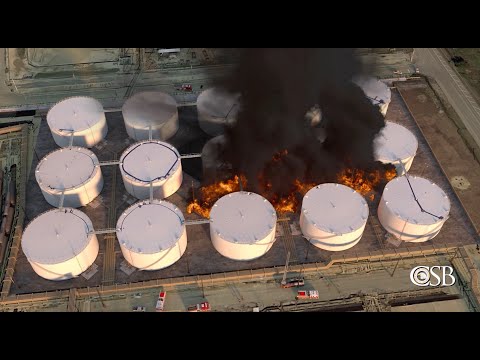
March 17, 2019 — An equipment failure and a cluster of missing safeguards at the International Terminals Company (ITC) Deer Park tank farm led to a large release of flammable liquid that ignited and spread to neighboring tanks, the U.S. Chemical Safety and Hazard Investigation Board said in a safety-video summary of its investigation.
The CSB identified a bearing failure on a pump serving tank 80-8 as the initiating event. Data in the control room showed changes in pump pressures and tank flow beginning early that morning, but the changes did not trigger alarms. The board found the pump’s mechanical-seal hardware loosened over hours and catastrophically failed shortly before ignition, allowing increasing volumes of butane-enriched NAPA product to escape.
The loss of containment persisted for roughly 30 minutes before a flame was observed at about 10:00 a.m., the CSB said. Responders on scene could not safely reach manual isolation valves once the tank area was engulfed; the tank farm did not have remotely operated emergency isolation valves that could have been closed from a safe location.
The escaping liquid and vapors ignited and the fire spread to 14 adjacent tanks within the common secondary containment area. ITC and local firefighters battled the blaze for three days and requested a third-party emergency response contractor to assist; responders ultimately extinguished the remaining tank fires on March 20. The CSB said the incident caused substantial facility damage and serious community disruptions, including shelter-in-place orders related to benzene in the air and closure of waterfront parks after containment walls breached and contaminated water reached the Houston Ship Channel.
The CSB’s review identified five primary safety issues that amplified the event: shortcomings in pump mechanical integrity programs, absence of flammable-gas detection near the tank, lack of remotely operated emergency isolation valves, tank-farm design that allowed rapid fire spread, and gaps in regulatory coverage under OSHA’s Process Safety Management (PSM) standard and EPA’s Risk Management Plan (RMP) rule.
On mechanical integrity, the board said ITC’s program excluded equipment handling materials the company did not list as regulated chemicals, so the circulation pump on tank 80-8 was not covered by more rigorous inspection and maintenance requirements the CSB judged necessary to catch the bearing problem earlier. "A formal mechanical integrity program for all pumps and highly hazardous chemical service could have prevented this incident," the presenter said.
Regarding detection, the CSB noted a 2014 hazard review recommended installing flammable-gas detectors near tank 80-8; ITC did not implement or document why it did not act on that recommendation. The board said detectors could have sounded an alarm during the roughly 30-minute release window and prompted actions to stop the outflow before ignition.
On regulatory gaps, the CSB highlighted that atmospheric storage tanks like 80-8 are exempt from OSHA’s PSM standard and that EPA’s RMP rule did not apply to the tank’s product as described in the video. The board recommended OSHA remove the atmospheric-tank exemption and asked EPA to expand RMP coverage to include flammable liquids with an NFPA flammability rating of 3 or higher. The CSB also urged the American Petroleum Institute to update guidance for terminals and tank facilities to explicitly consider flammable-gas detection systems.
The board estimated the fire caused more than $150 million in property damage at the facility and described prolonged environmental cleanup after the containment breach. The CSB recommended ITC evaluate tank-farm design, containment and drainage systems and urged industry and regulators to adopt the safeguards it identified to reduce the likelihood and impact of similar incidents.
The CSB concluded its summary by saying the incident and the regulatory gaps it revealed make stronger preventive measures and updated guidance necessary to protect workers, emergency responders and nearby communities. For the full investigation and recommendations, the CSB directed viewers to csb.gov.