Get Full Government Meeting Transcripts, Videos, & Alerts Forever!
Get email alerts on the Governance topic
No spam. Unsubscribe anytime.
Council debates proclamation rules, agenda timing and public‑comment limits
Summary
During a review of the council protocol manual, members weighed whether proclamations should be vetted by the agenda committee and whether applicants can read proclamations in meetings; the panel also discussed agenda deadlines, public‑comment timing and remote‑comment security.
City Council spent much of its Feb. 24 study session reviewing proposed edits to the council protocol manual and aired competing views about how proclamations, agenda placement and public comment should be handled.
City manager Mark opened the review and noted recent feedback on proclamations and ceremony procedures. Council members debated whether proclamations should continue to be the mayor's prerogative or be vetted and placed on the agenda by the agenda‑setting committee or a study session. One council member argued that if the council does not want a proclamation "then four of us should make that decision," while others said the city should keep proclaiming community observances and that applicants who want to be recognized should be allowed to read the proclamation themselves.
Members generally favored bringing proclamations to a study session for council consideration before placing them on a business agenda, with the option to allow applicants to read the proclamation at the meeting if the council declines to adopt it. City manager Mark said he would draft language to clarify the process in section 5.04 of the manual.
Council also discussed agenda‑placement rules (8.05) and timeline expectations. Current practice allows council members to request an item be placed on the agenda by making an oral request or submitting it in writing at least 10 working days before a meeting; advisory boards and proclamations have longer lead times. Several members said 10 days is reasonable for council members but noted that items requiring staff research, legal review or public hearings will need substantially more lead time.
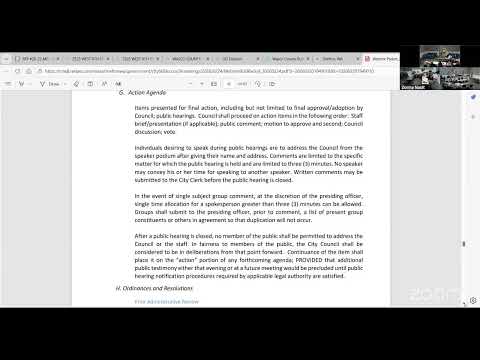
Public comment procedures drew sustained discussion. The manual currently allows a three‑minute limit per speaker and no overall maximum; council members considered adopting a fixed cap for total public comment (the county’s model of a 50‑minute cap was cited) or dynamically shortening individual times when many speakers sign up. Several council members said they prefer to preserve three minutes per speaker unless a large crowd forces a reduction, and staff noted the council can, by majority agreement at a meeting, reduce per‑speaker time for that night.
The group also discussed remote public comment. City staff said remote sign‑up must be completed by 4:00 p.m. the day of the meeting and acknowledged past security issues with remote participation; members said any expansion of remote comment should include staff capacity to secure and monitor the system.
Other protocol items covered included adding council "group agreements" (behavior standards) to the manual, and exploring whether the city could place a council member on certain county boards via interlocal agreements to better coordinate regional projects. Council asked staff to review options and return with recommended language and process timelines.
No formal amendments to the protocol manual were adopted during the study session; city manager Mark will prepare language edits and staff will follow up on board‑representation options and remote‑comment security.