Get Full Government Meeting Transcripts, Videos, & Alerts Forever!
Get email alerts on the Land Use Zoning topic
No spam. Unsubscribe anytime.
Harrisburg board upholds staff: special‑use permit required for Ventor Chemicals’ proposed on‑site landfill
Summary
After testimony from Ventor and technical witnesses and a staff presentation, the Town of Harrisburg Board of Adjustment denied Ventor Chemicals’ appeal and upheld staff’s determination that the proposed on‑site industrial landfill requires a special‑use permit under the town’s UDO.
The Town of Harrisburg Board of Adjustment on Feb. 6, 2024 denied an appeal from Ventor Chemicals LLC that sought to treat a proposed on‑site industrial landfill as a use permitted by right. The board concluded town staff correctly interpreted the Unified Development Ordinance (UDO) and that the proposed facility falls within heavy‑industrial uses that require a special‑use permit.
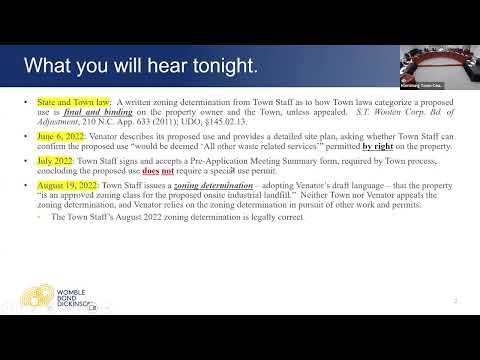
Ventor’s attorney, Mike Thielen, told the board the company requested an interpretation in June 2022 and received an August 19, 2022 zoning verification letter. Reading from that letter at the hearing, Ventor’s witness Jonath Stein said the letter stated: “The current zoning is an approved zoning class for the proposed on‑site industrial landfill.” Thielen said Ventor relied on that determination over roughly 15 months, invested in final design and submitted technical materials to the North Carolina DEEQ in November 2023.
Town staff and the planning director, Zach Cordon, told the board those facts did not relieve Ventor of other UDO requirements. Cordon cited the UDO definitions that distinguish heavy industrial, light industrial and waste‑related uses and said the proposed landfill does not meet the town’s definition of a waste‑related use (which requires receipt of waste from others). He summarized staff’s position: the site’s EC (employment center) zoning permits heavy‑industrial activities only after a special‑use review and the August 2022 letter was a zoning snapshot, not an administrative waiver of the UDO’s special‑use requirement.
Technical witnesses for Ventor and its consultant ERM described why the company selected an on‑site landfill. ERM’s senior engineer testified that options (off‑site disposal, dewatering/geo‑tubes, hauling) were considered and that onsite disposal would allow Ventor to manage long‑term capacity; he described the planned facility as lined with high‑density polyethylene and estimated roughly 30,000–35,000 cubic yards of lagoon sediments initially would be placed in the landfill. Ventor witnesses emphasized the project would accept only on‑site generated sediment, not material from other sites.
Staff rebutted Ventor’s reliance argument on two key points: that the August 2022 letter did not state a special‑use permit was unnecessary and that the town’s subsequent November 15, 2023 correspondence (and a November 2, 2023 pre‑application summary) made clear staff required a special‑use process. Staff also distinguished the case law cited by Ventor — a court of appeals decision often called St. Wooten — noting factual differences in that precedent (in Wooten an operating facility had already been established and the landowner had substantially completed construction and permitting before the town later challenged the use).
After questions from board members about the scope of the parcel and whether past approvals (including a 2002 conditional‑use permit for tank storage and related work) applied to modification of the site, the board voted to deny Ventor’s appeal and directed the board attorney to prepare a written order. The board’s recorded action notes the motion to deny passed and that one board member opposed; the exact roll‑call tally was not specified in the hearing record.
The hearing record shows competing but reasoned interpretations of the UDO. Ventor argued the town’s August 2022 zoning verification adopted language Ventor provided and that the company reasonably relied on the town’s response when it advanced substantial design work and sought state approvals. Town staff argued the August letter was an administrative zoning verification that did not and could not substitute for the UDO’s formal special‑use review when the UDO’s definitions and Table 1402‑2 require special use approval for heavy‑industrial activities in the EC zone.
What happens next: the board’s denial leaves in place the town’s requirement that Ventor pursue a special‑use permit before constructing the proposed on‑site industrial landfill. Ventor previously filed a parallel special‑use application; the town’s staff report and other exhibits on the record will be used for that process and for the written order the board directed its attorney to prepare.