Get Full Government Meeting Transcripts, Videos, & Alerts Forever!
Get email alerts on the Stormwater Maintenance topic
No spam. Unsubscribe anytime.
Topeka staff tell property owners they are responsible for inspecting and maintaining stormwater BMPs
Summary
City of Topeka trainers told property owners at a public workshop that once a stormwater Best Management Practice (BMP) is built it becomes the owner’s responsibility to inspect, maintain and document work to remain compliant with the city’s MS4 permit and the Topeka Municipal Code.
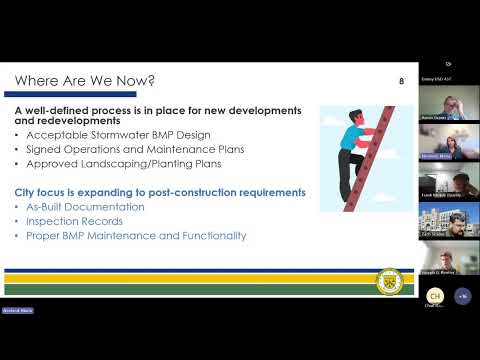
City of Topeka staff told property owners at a training session that maintaining post-construction stormwater best-management practices is the owner’s responsibility and a requirement of the city’s stormwater permit program. Maria Neland of Benish, who led the presentation, said the session was meant to explain inspection, maintenance and recordkeeping for BMPs such as detention basins, rain gardens and permeable pavement.
“Once a storm water BMP is constructed, it becomes the responsibility of the property owner for inspection, maintenance,” Neland said, urging owners to use the City of Topeka’s BMP maintenance guide and inspection forms.
Why it matters: The city operates under a municipal separate storm sewer (MS4) permit and must demonstrate to the Kansas Department of Health and Environment (KDHE) and the U.S. Environmental Protection Agency (EPA) that it is reducing pollutant loads and managing runoff. City staff presented the BMP design handbook and an owner’s maintenance guide as tools to meet those obligations and to protect downstream areas and infrastructure.
What owners must do: Trainers outlined a three-part routine for long-term compliance. Owners should perform informal inspections after rain, snow or landscaping events and complete formal inspections during the growing season (April 1–Sept. 30). The city’s guidance calls for formal inspections every two years and a professional inspection by a licensed engineer or architect at least once every six years. Owners must retain inspection and maintenance records for six years and submit documentation to the city when required.
Common problems and fixes: Presenters listed frequent issues owners should look for—sediment and debris at inlets, evidence of erosion or settlement, clogged outlets causing ponding, and damaged vegetation or compaction from vehicle traffic. “If the system is not dewatering within about 48 hours after a rain event, that could indicate clogging or other problems,” Neland said. Remedies range from manual clean-out to vacuuming sediment or hiring a contractor for more extensive repairs.
Protection and coordination: Trainers warned against encroachments—fences, sheds, parking or landscaping—that can impair BMP function and urged clearly marked access routes for maintenance and inspections. They also recommended avoiding fertilizers and pesticides in BMP areas and coordinating with landscapers and site operations to prevent damage.
Resources and next steps: Staff pointed attendees to the City of Topeka stormwater webpage for videos, the BMP design handbook and the owner’s BMP maintenance manual, and invited property owners to contact stormwater staff (listed during the session) for help locating records or understanding site-specific requirements. Neland closed by reminding owners that the city ordinance grants inspection authority and that failing to maintain BMPs can lead to enforcement action.
The workshop concluded with an invitation for questions and offers of individual follow-up from city staff.