Get Full Government Meeting Transcripts, Videos, & Alerts Forever!
Get email alerts on the School Case Study topic
No spam. Unsubscribe anytime.
Principal: School-designed professional development helped cut chronic absenteeism at Robert F. Kennedy Elementary
Summary
Principal and community-school staff told the LAUSD Curriculum & Instruction Committee that locally designed professional development, community-based learning and sustained planning time helped reduce chronic absenteeism and improve teacher retention and engagement at Robert F. Kennedy Elementary. Presenters warned sustainability depends on protected funding and clearer district alignment.
The principal of Robert F. Kennedy Elementary told the Los Angeles Unified School District Curriculum & Instruction Committee that school-led professional development and community-centered, project-based learning helped reduce the school's chronic absenteeism dramatically.
"At one point we were at 46% chronic absenteeism. We are 19% right now," the principal said, attributing the change to locally designed PD, community partnerships and student-centered programs such as project-based learning and digital portfolios. The principal identified herself only as "Martha" in the transcript; a community schools coordinator present was named Martha Gonzalez.
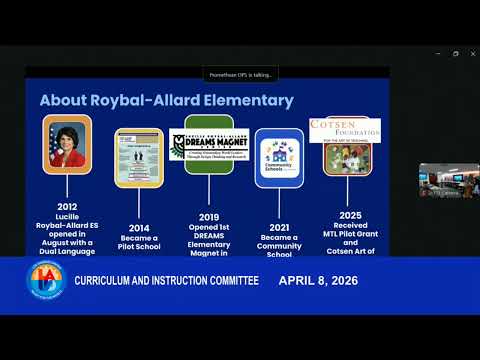
The school presentation described an array of locally developed PD and student programs: dual-language and magnet pathways, teacher-led PLCs and "appy hours" for targeted tech skills, anti-racist curriculum work, the "joyful disruptions" SEL series, student-led digital portfolios and community-facing projects such as a Minecraft tiny-home design challenge. Staff-led trainings included neurodiversity and inclusion sessions run by special-education staff, and every classroom was reported to have a "calm corner" for students who need brief breaks.
Why it matters: LAUSD committee members have been debating how much PD content and time should be set by the district versus by schools. The Robert F. Kennedy presenters argued that when schools are allowed to design PD that matches community needs, teachers show higher engagement and students demonstrate measurable gains in attendance and school-experience surveys.
The principal and staff pointed to multiple measures of impact: upward-trending attendance and parent-engagement metrics on the community-schools dashboard, a reported 100% teacher satisfaction rate at the site for several years, and district recognitions including a California Gold PBIS award and a magnet merit award of distinction. "We have data from multiple sources that show our staff and families are engaged," the presenter said.
Sustainability and constraints: presenters repeatedly warned that the model requires sustained time and funding for planning. They noted the school relied on community-schools funding (including a collaboration grant identified in the transcript as the 7339T grant) to buy protected planning time; they said that some of that collaboration money may be lost next year and that the school will advocate to keep it. Committee members asked how the model could scale to schools without pilot-school governance and whether the work could survive leadership turnover; presenters pointed to pilot-school hiring practices and staff agreements as partial safeguards but emphasized the need for district alignment.
Public comment and follow-up: committee members and attendees asked for clearer guidance on how district policy could preserve planning time and support consistent implementation across regions. The principal urged the district to match funding to any expectation of embedded planning time so schools can translate PD into classroom practice.
Next steps: the committee will continue to discuss PD flexibilities and funding options; presenters encouraged visiting the school to see the practices in action. The meeting moved next to a district-level presentation on bank-time PD modules and SEL implementation.