Get Full Government Meeting Transcripts, Videos, & Alerts Forever!
Get email alerts on the Arts And Culture topic
No spam. Unsubscribe anytime.
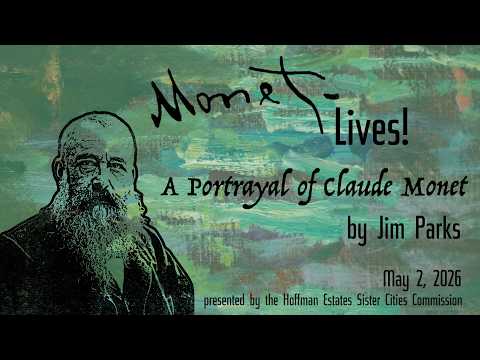
Hoffman Estates Sister Cities Commission hosts Jim Parks in Claude Monet performance
Summary
Evanston artist Jim Parks performed as Claude Monet at a spring Sister Cities Commission program in Hoffman Estates, recounting Monet’s struggles with the Salon, the development of plein‑air technique, and his Giverny water‑garden series; the event included a Q&A and a display of 60 tiny reproductions.
The Sister Cities Commission of Hoffman Estates hosted a spring program featuring Evanston artist Jim Parks, who performed as Claude Monet and walked the audience through Monet’s life, methods and the rise of Impressionism.
Chair Lillian Mosier opened the event by introducing Parks and noting the commission’s longevity and international ties: "My name is Lillian Mosier, and I'm the chair of the Sister Cities Commission," she said, adding that the commission has 17 members and is marking a 30th anniversary with the city of Angoulême. Mosier described Parks’s tiny reproductions of Impressionist works that attendees held up during the talk and joked that the paintings would be gathered at the end of the program: "We're looking for 60 back."
Performing in character as Claude Monet, Parks narrated the artist’s early years in Le Havre, his caricature work selling in shop windows, and how meeting painter Eugène Boudin led him to paint en plein air. Parks emphasized the movement’s break with academic conventions, saying the Salon system prized antiquity and detailed finish while the Impressionists sought spontaneity and the effects of light. "Spontaneity," Parks said in the Monet persona, "is the improvisation."
Parks recounted the long period of rejection and ridicule the Impressionists faced, their independent exhibition in Nadar’s studio and the harsh critical responses they initially received. He described friendships and financial support among the group — naming Frédéric Bazille and Auguste Renoir among those who helped Monet — and credited later American collectors with helping raise the market for Impressionist works.
The presentation included concrete descriptions of Monet’s technique: using paint tubes to work outdoors, experimenting with "broken color" by placing patches of pure hues on the canvas, and painting series of the same subject at different times and seasons. Parks highlighted Monet’s move to Giverny, the construction of his water garden and Japanese bridge, and his serial works such as the grain‑stack and water‑lily series that concentrated on light and color.
Parks also addressed Monet’s later life: his large mural project intended for public display, persistent vision problems and multiple surgeries, and his eventual recognition and placement in museum collections. In character, he said Monet died in 1926 and reflected on how recognition and changing markets altered the artists’ fortunes.
The program ended with a short audience Q&A about Monet’s finances and reception, a few lighthearted personal questions (including whether Monet had paid back relatives who supported him) and closing thanks from the commission before lunch. The presentation combined historical anecdotes and demonstration of process with audience interaction; no formal actions, votes or policy decisions were part of the event.
Mosier and Parks remained the principal speakers; Parks' performance emphasized pedagogy and storytelling rather than policy or civic decisions. The commission’s celebration of its sister‑city link with Angoulême and the public cultural program were the event’s central outcomes.