Get Full Government Meeting Transcripts, Videos, & Alerts Forever!
Get email alerts on the Public Safety topic
No spam. Unsubscribe anytime.
Sheriff outlines drone-as-first-responder pilot after 2025 workload spike
Summary
Sheriff JD Hartman told the Mocksville Town board a planned live test of a drone-as-first-responder system could cut response times dramatically in the busiest zones; the initiative will start as a two‑drone test integrated with 911, fire partners and camera vendors.
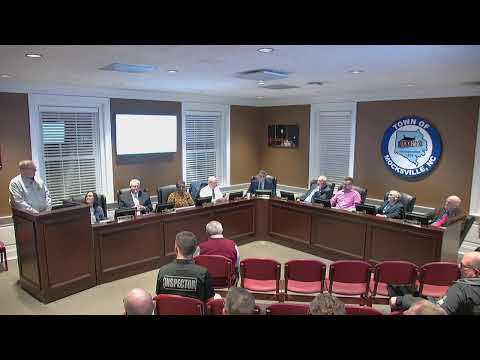
Sheriff JD Hartman presented a detailed proposal to make drones a first responder in parts of Mocksville and the surrounding county, saying the technology could put "eyes on the scene" well before ground units arrive.
"For the calendar year of 2025, we had 39,869 man‑hours inside Mocksville town limits," Hartman said, adding that equates to roughly 19 full‑time officers deployed across calls in town. He said 4,230 calls were handled in town in 2025 and 87.4% of those were answered inside the 9‑minute contractual target. Hartman said the vendor impact analysis showed that, in the proposed coverage circles, drones could reach scenes in about 2 minutes 42 seconds on average and reduce response times by an estimated 75% compared with current ground response averages.
Hartman described the planned test as two remotely launched drones plus a radar system and a working‑group protocol involving county 911, existing municipal and volunteer fire drone teams, and county IT. He said the project would re-use existing partnerships (including the vendor Flock) and the county27s backup 911 center at the courthouse as a potential drone‑operations hub, reducing equipment and facility costs.
The sheriff framed practical uses the county already sees: quickly clearing low‑priority calls (for example, false crash or Ring‑camera checks), providing hot‑spot thermal imagery for firefighter decisions, and tracking fleeing vehicles to feed license‑plate matches into camera networks. He said the live test will focus on the county27s busiest zones with a hoped start in late February and could run up to two years.
Hartman acknowledged state agencies and other law‑enforcement programs are still learning to operate remotely and said the county aims to build a shared, cross‑agency program that also supports nonpublic‑safety uses, such as water‑tower and sewer inspections, to increase equipment utilization.
The board did not take a formal vote that night on deployment; Hartman invited questions and signaled the next steps are working‑group protocol development and the planned test phase.