Get Full Government Meeting Transcripts, Videos, & Alerts Forever!
Get email alerts on the Workforce Housing topic
No spam. Unsubscribe anytime.
Regional land-trust plan and 14-acre gift spotlight workforce-housing push in Clarkdale
Summary
Mary Shaquen, executive director of the Verdie Valley Community Development Organization, told Clarkdale’s council the nonprofit has compiled regional planning tools, a developable‑land database and a community land trust; she announced a $550,000 donation for 14 acres intended for roughly 45 workforce homes.
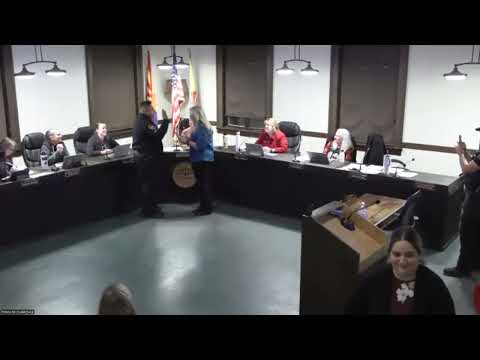
Mary Shaquen, executive director of the Verdie Valley Community Development Organization, told the Clarkdale Town Council on Dec. 9 that the nonprofit is coordinating a regional effort to create and preserve workforce housing through education, planning and a community land trust.
Shaquen said the organization has established a 35-member housing advisory committee representing municipalities, nonprofits, developers and Yavapai College, produced a developable‑land database linked to municipal contacts, conducted a cost‑to‑build study and created regional marketing assets to correct misinformation about housing and density. “We shape resilient communities through regional collaborations and alliances,” Shaquen said in her presentation.
The centerpiece of the CDO’s proposal is a community land trust in which the nonprofit retains ownership of land in perpetuity and sells only the vertical structure to qualifying workforce buyers under a long ground lease. Shaquen explained the model’s mechanics: the land trust would sell houses below market by separating land value from the house, grant a 99‑year ground lease to the buyer at a low annual payment, and limit resale appreciation so the house remains affordable to future workforce buyers.
“We closed the $550,000 gift and we now own those 14 acres of land,” Shaquen said, announcing a donation of 14 acres on Highway 260 that the CDO intends to develop under the land‑trust model and — she said — could yield roughly 45 single‑family homes. She described the target population as middle‑income workers priced out of the region and framed the initiative as one way to attract younger families and slow demographic decline.
Shaquen said the CDO is pursuing several next steps: refine the cost‑to‑build analysis to match recently mandated municipal housing templates (800, 1,250 and 2,000 square feet), continue to augment the developable‑land database with county GIS layers, present to planning and zoning bodies and solicit municipal support and private donors to sustain operations.
Council members asked for clarifications about housing types, equity splits on resale and safeguards if the nonprofit dissolved. Shaquen said the board intends homes to be sold (not rented) under the land‑trust rules, that resale formulas are set in the purchase agreement, and that bylaws require assets to transfer to another land trust if the CDO were to fold. “Our board has decided that we will only sell to individuals who are making 150% or less of the Yavapai County AMI,” she said.
Several council members questioned the exclusive focus on single‑family homes and noted multifamily or denser models can lower per‑unit costs; Shaquen said insurance market constraints for duplexes and triplexes and local demand research informed the initial single‑family approach but that the CDO may expand to other housing types over time.
Shaquen closed by asking the council to consider financial support, help identifying potential properties and to amplify the CDO’s outreach materials. The council did not take formal action on funding at the meeting.
The CDO presentation was the council’s primary substantive discussion item on the Dec. 9 agenda. The council next took up a code amendment related to water‑service inventories.