Get Full Government Meeting Transcripts, Videos, & Alerts Forever!
Get email alerts on the Wildfire Insurance topic
No spam. Unsubscribe anytime.
Senate hearing urges targeted home‑hardening, data systems and durable mitigation funding to stabilize California’s wildfire insurance market
Summary
Senators heard experts, insurers and builders urge a coordinated, targeted state mitigation framework, improved data and funding to reduce wildfire losses and restore insurance availability; regulators said early market signals show progress under the Sustainable Insurance Strategy (SIS).
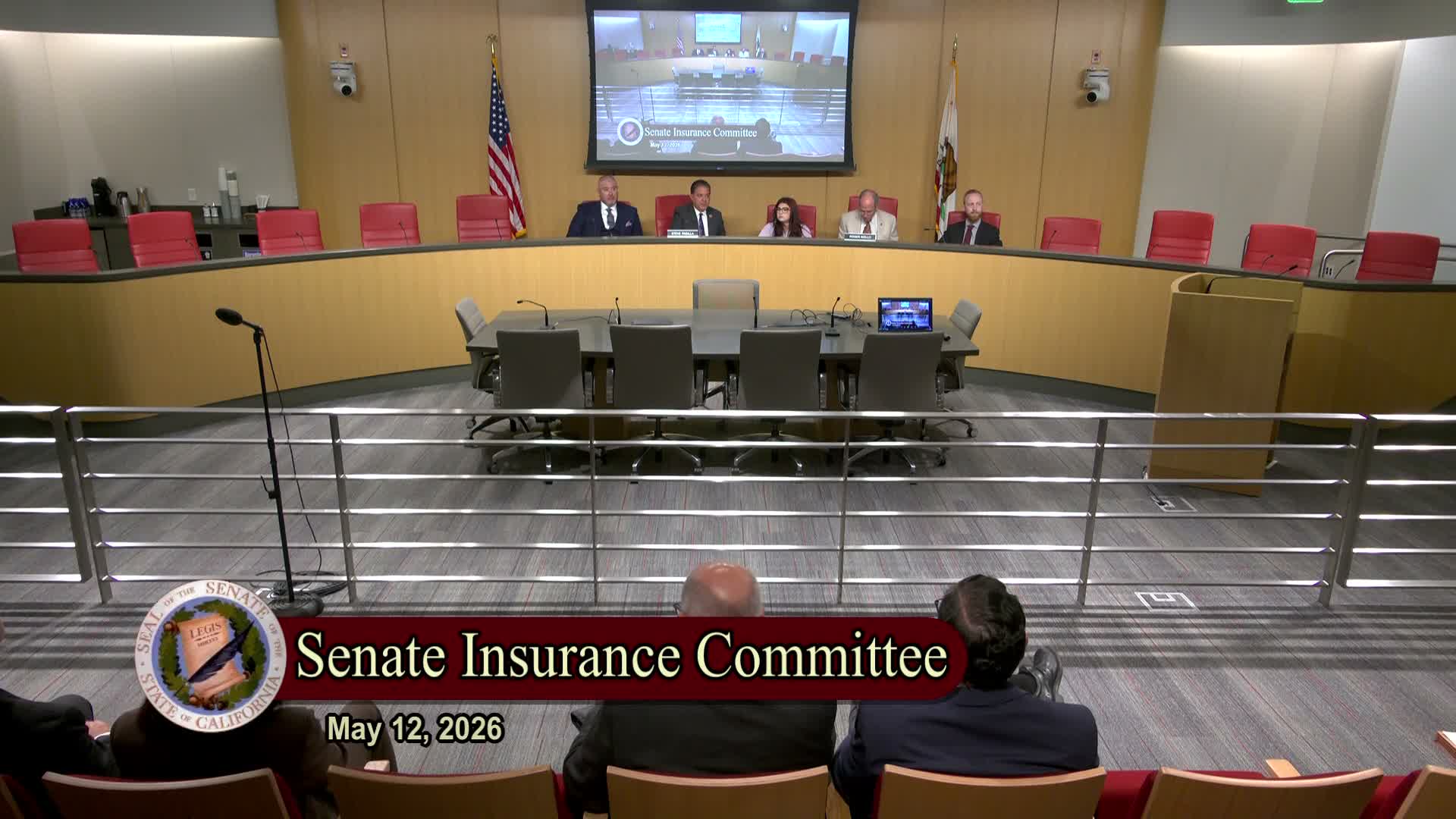
The California State Senate Committee on Insurance convened an informational hearing to examine the SB 254 natural catastrophe resilience study and the many ways climate‑driven wildfires are reshaping the state’s homeowners insurance market.
Experts and state officials told senators that the path to improving availability and affordability depends on reducing structure losses through targeted home hardening and community mitigation, modernizing data and modeling, and creating stable funding for mitigation grants and verification.
The committee heard from consumer advocates, actuaries, fire scientists, builders and the state insurance regulator. Amy Bach of United Policyholders warned that “reduced availability, reduced affordability, reduced competition” are the present realities and highlighted growing use of surplus (non‑admitted) carriers that are not subject to the same rate and solvency oversight. Milliman actuary Nancy Watkins said insurers have been cutting the riskiest policies to balance their finances and recommended a two‑part solution: cut expenses by reducing community risk, and raise income with a sustainable insurance framework that allows actuarially sound pricing. “To get the highest and the fastest results on the money that we need to spend to reduce wildfire risk, I believe that we need a state mitigation framework,” Watkins testified.
Stanford’s Michael Wara urged targeting mitigation to dense, older neighborhoods where close house spacing and older construction drive conflagration risk, noting that “we are burning down too many houses” and that utility‑related ignitions account for a large share of recent structure losses. Frank Freebalt of Cal Poly’s Wildland Urban Interface Fire Institute and UC Berkeley’s Michael Golner described the science behind ember‑driven structure ignitions and said widespread application of defensible space and home hardening could materially reduce structure losses in many communities.
Builders also described solutions. Dan Dunmoyer of the California Building Industry Association said whole‑neighborhood approaches built to IBHS standards are being piloted and can make new communities resilient while creating a protective buffer for older housing stock over time.
Insurance Commissioner Ricardo Lara told the committee that the Department of Insurance’s Sustainable Insurance Strategy (SIS) and recent regulatory actions are helping restore market participation. He said several major insurers have filed under the SIS to write and maintain more policies in high‑risk areas and that FAIR Plan growth has slowed in recent quarters—signs he characterized as early market stabilization. Lara outlined priorities from the SB 254 study: an achievable community mitigation standard, a public wildfire catastrophe model and a public mitigation data repository to guide state investments and insurer recognition. He noted that permanent, targeted funding for mitigation grants is not yet in place and suggested using a small share of premium taxes or dedicated fees as possible mechanisms.
On the contentious question of who pays for large‑scale mitigation, witnesses and members offered tradeoffs: homeowners, local governments and utilities will have roles, but many urged state matching funds and targeted grants to close the affordability gap for lower‑income and rural communities. Several witnesses pointed to successful programs in other states that combined public funding and neighborhood effects to scale up mitigation quickly.
Committee members pressed witnesses on specifics: how to measure mitigation efficacy (the so‑called Zone 0 and IBHS five‑foot standard was discussed), how to identify and prioritize the highest‑impact homes and neighborhoods, and how to ensure equity so that ratepayers in low‑risk areas do not shoulder disproportionate costs without commensurate benefits.
Public comment echoed those themes. Consumer Watchdog and NRDC representatives urged the committee to ensure insurers honor mitigation discounts promised under SIS and to avoid funding approaches that would regressively burden electricity customers.
No formal votes or motions were taken at the informational hearing. The committee signaled it will continue follow‑up hearings and legislative work to translate the SB 254 recommendations into standards, data systems and funding mechanisms.
Sources: testimony and exchanges in the Senate Committee on Insurance informational hearing on the SB 254 natural catastrophe resilience study. Direct quotes and numerical estimates are attributed to witnesses and the Insurance Commissioner as presented in their testimony.