Get Full Government Meeting Transcripts, Videos, & Alerts Forever!
Get email alerts on the Rural Philanthropy topic
No spam. Unsubscribe anytime.
Seeley Lake Community Foundation highlights rural wins: glass recycling, Change Your Pace and a community needs assessment
Summary
Seeley Lake Community Foundation told City Club attendees how small, relationship-based philanthropy supported local programs: $2 million distributed over 25 years, a $700,000 endowment, a glass-recycling program diverting 50,000+ pounds and a Change Your Pace Challenge nearing $1 million; the foundation plans a public community needs report in 2027.
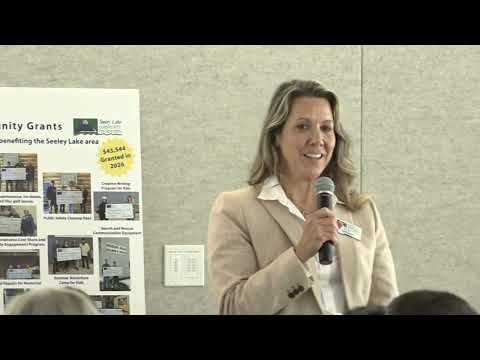
SEELEY LAKE — Claire Mueller, executive director of the Seeley Lake Community Foundation, laid out how a small rural foundation uses local relationships and matching strategies to move money and build capacity.
"Our first 25 years, the Seeley Lake Community Foundation distributed nearly $2,000,000 into the community while growing our endowment to more than $700,000," Mueller told a City Club of Missoula audience. She described programs ranging from a glass-recycling initiative that has diverted more than 50,000 pounds of glass and raised more than $34,000 for local schools to a Change Your Pace Challenge that has raised nearly $1,000,000 for the Cedar Lake area since 2016.
Mueller emphasized that rural philanthropy is relationship driven: direct mail, word-of-mouth and local matches still work, she said, noting that a month-long giving campaign fits rural rhythms better than a single-day event. Mueller also previewed a community needs assessment the foundation is launching to collect interviews, focus groups and a survey; the foundation expects to release a public-facing report in 2027.
The presentation highlighted how small, locally managed funds can underwrite transportation help for seniors, stabilize farmers' markets and run education programs linking retirees with students. Mueller said Seeley Lake's approach combines convening, lightweight contracting with service providers (for example, Recycling Works in Missoula), and matching donors with operational needs.
The forum discussion underscored differences in scale between urban and rural foundations but illustrated how local tactics and matching funds can produce measurable outcomes in smaller communities.