Get Full Government Meeting Transcripts, Videos, & Alerts Forever!
Get email alerts on the Wildfire Fund Financing topic
No spam. Unsubscribe anytime.
California senators probe $36 billion wildfire fund options, weighing ratepayer costs and liability reforms
Summary
A Senate informational hearing on the SB 254 resiliency study examined options to make California's wildfire fund durable — including larger capital, risk transfer, state backstops and liability reform — and highlighted sharp disagreements over who should shoulder costs and how survivors should be paid promptly.
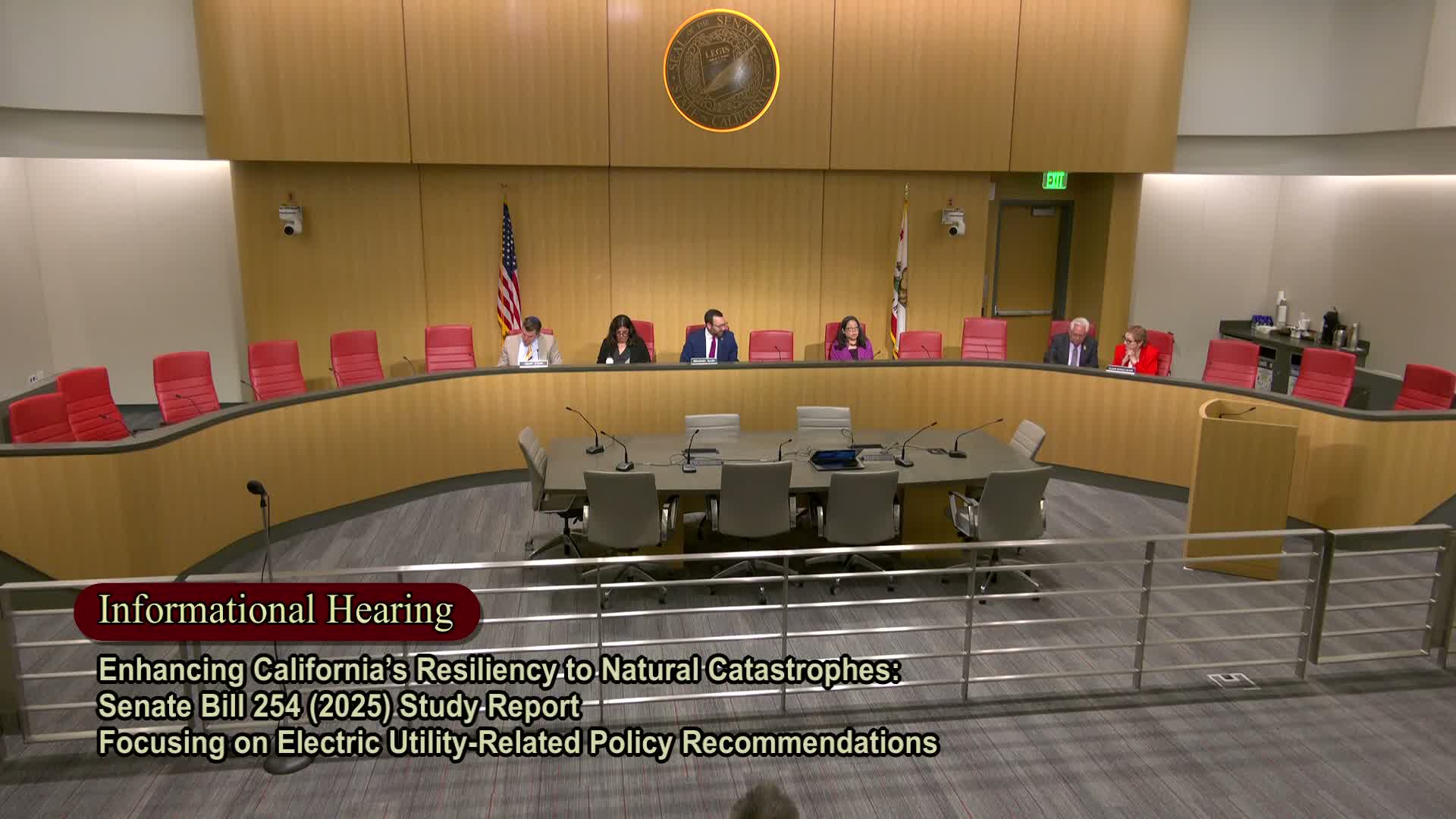
Chair Allen opened an informational hearing of the California State Senate on the SB 254 natural catastrophe resiliency study, framing the session as the first of several reviews that will examine how to make the state's wildfire fund more durable in the wake of recent catastrophic utility-caused fires.
The hearing featured a presentation from the California Earthquake Authority and its consultants, who laid out three policy pathways and a set of options for funding and governance. Tom Welsh, CEO of the California Earthquake Authority, described the fund's origins under AB 1054 and told the committee the report evaluated a spectrum of policy approaches without endorsing a single outcome.
Dr. Lori Johnson summarized three policy pathways: (1) continue and strengthen mitigation investments, (2) equitably allocate catastrophe burdens across insurers, utilities and the public, and (3) consider state-led financing and insurer-of-last-resort options. Andy Neal of Aon, who led the financing work stream, presented modeling that estimated an initial capitalization need of about $36 billion for a more durable wildfire fund but said risk transfer could reduce initial capital needs to roughly $11 billion at the cost of ongoing premiums. Neal cautioned that the estimates are intentionally directional and that a 75% 20-year solvency metric leaves significant uncertainty.
The panel also described options to change liability rules. Those alternatives range from preserving safety-certificate accountability and adopting confidential near-miss reporting systems, to more consequential proposals such as modifying or eliminating inverse condemnation for utility-caused wildfires, which would require a constitutional change. The report also analyzed changes to damage calculations and subrogation rules.
Forrest Kaiser of the California Public Utilities Commission said the regulatory framework has strengthened and that mitigation has reduced ignition risk, but he warned the current approach places an unsustainable cost burden on ratepayers. Tony Marino of the Office of Energy Infrastructure Safety described oversight tools for wildfire mitigation plans, including field inspections, independent evaluations and performance oversight.
Legislators pressed the panel on trade-offs: whether to socialize costs via non-bypassable charges, target surcharges to high-fire-threat areas, buy reinsurance, cap damages, or create state backstops. Several senators urged a holistic package rather than piecemeal bills. Concerns included potential impacts on affordability, utility creditworthiness, local government budgets and survivor compensation timelines.
Survivors and consumer advocates urged protections for victims and faster compensation. Joy Chen, executive director of the Every Fire Survivors Network, said survivors remain displaced and called for urgent housing relief and a state-managed fast-pay facility so that people are not left to exhaust savings while investigations and litigation proceed. Utilities and municipal utility advocates argued reforms must avoid imperiling utility finances that fund mitigation and long-term grid investments.
The committee did not vote on policy; senators said the SB 254 study will inform further hearings and legislation across multiple committees, including insurance, natural resources and emergency management. The hearing underscored deep divisions over liability reform and a central policy tension: reduce the risk of catastrophic wildfires through mitigation and oversight, while deciding who ultimately bears the costs — shareholders, ratepayers, taxpayers or a mix of those groups.