Get Full Government Meeting Transcripts, Videos, & Alerts Forever!
Get email alerts on the Legislation Votes topic
No spam. Unsubscribe anytime.
Senate passes package of bills: disability accommodations, egg donations, elections, campaign-finance changes and tougher impersonation penalties
Summary
On May 13, 2026 the Minnesota Senate passed a series of bills — including changes to disability‑accommodation language, a law allowing donation of eggs past quality‑assurance dates, elections and campaign‑finance adjustments, and a stiffer penalty for impersonating peace officers — and confirmed tax‑court appointments.
The Minnesota Senate on May 13, 2026 approved a set of measures ranging from human‑rights language changes to public‑safety penalties and confirmed three tax‑court judges.
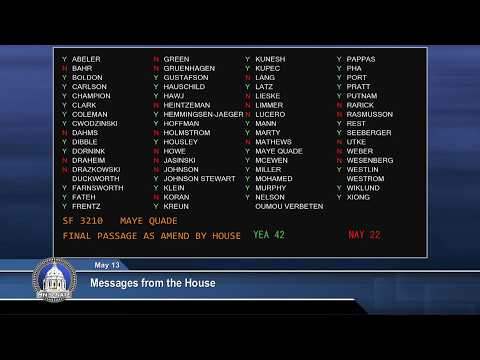
Senators concurred in House amendments to Senate File 3210, which adds the word “reasonable” to accommodation language and refers to the definition of disability in the Minnesota Human Rights Act; the Senate repassed the bill as amended and recorded 42 ayes and 22 nays. Senator Maquade explained the house changes and urged concurrence.
On an agriculture measure, the Senate passed Senate File 3891, which allows retailers to donate chicken eggs up to 30 days past their quality‑assurance date when still safe to eat. Sponsor Senator Maquade argued that the change would reduce food waste and expand supplies to food shelves; the bill passed 65‑0.
The chamber adopted an elections administration bill, House File 4240, after adopting a floor amendment that replaced a section and struck an appropriation; the bill passed final passage 36‑28. Senator Westland said the amendment aligns the bill with interchamber agreements and preserves language to guarantee at least one polling place in certain school‑district elections.
The Senate also approved House File 4239, a campaign‑finance bill that adds a four‑second audio/visual disclosure requirement for some political ads, narrows public access to certain street‑address data in campaign reports while allowing limited caucus‑leader access for official purposes (with a 30‑day deletion requirement), and permits the Campaign Finance Board chair to dismiss frivolous complaints. Senator Westland described the changes as bipartisan and responsive to the Campaign Finance Board’s recommendations; Senator Abler asked for clarification about the new four‑second requirement and was told it is an immediate effective date and grew out of court guidance. The bill passed final passage 46‑21.
House File 3404, increasing penalties for impersonating a peace officer, passed unanimously, 67‑0; sponsors and supporters said the measure restores public trust in law‑enforcement identification.
The Senate confirmed three Minnesota Tax Court appointments on the confirmation calendar after committee recommendations; the confirmations were approved by motion.
Senators also adopted Senate Resolution 86, which updates interim conduct rules and allows the secretary to appoint someone to fill a vacancy in an elected officer position during the interim; it passed 57‑0. Senate Resolution 87, commemorating deceased senators, was adopted by voice vote.
The chamber recessed at the call of the president after announcing conference committee appointments. The Senate’s proceedings on these measures were driven largely by floor explanations and brief debate; recorded votes and roll calls are listed in the legislative journal.