Get Full Government Meeting Transcripts, Videos, & Alerts Forever!
Get email alerts on the Alpr Policy topic
No spam. Unsubscribe anytime.
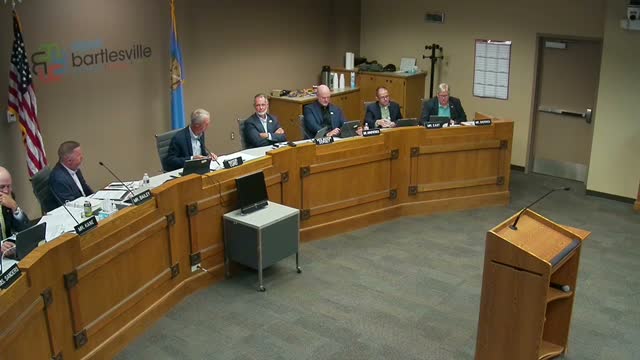
Bartlesville council pauses action on Flock ALPR rules after debate on warrants and limits
Summary
Councilman Tim Schierk presented two alternatives for regulating automatic license‑plate readers: require judicial warrants for investigative access or limit devices to parking enforcement. Police described cases where ALPR aided investigations. The council took no action pending further vendor review and potential refinements.
Councilman Tim Schierk asked the Bartlesville City Council to consider tightening rules for automatic license‑plate readers, presenting two alternative amendments to Ordinance 3600 that governs the city’s use of Flock ALPR technology.
Schierk outlined option A, which would add judicial oversight to investigative queries by requiring a warrant, court order or subpoena before stored ALPR data may be accessed, while preserving narrow exigent‑circumstance exceptions. "There are 2 options," Schierk said, describing a warrant requirement intended to mirror judicial review trends emerging elsewhere. He argued the change would address Fourth Amendment concerns tied to aggregated location records.
The warrant proposal references U.S. Supreme Court guidance in Carpenter v. United States on aggregated location data and notes that several municipalities and states have moved toward judicial authorization for similar datasets. Schierk said option B — his stated personal preference — would be stricter: it would limit ALPR deployment to parking‑time enforcement only and require purging previously collected law‑enforcement ALPR records and a 60‑day wind‑down for equipment repurposing.
Acting Police Chief (speaking for the department) described operational benefits and urged the council not to restrict current use. "As acting police chief, I, along with all the officers of the Bartlesville Police Department, support the use of Flock and ALPR technology," he said, and the department presented data it said demonstrated the system’s public‑safety value. Deputy Chief Ward and Captain Elkins recounted cases they said the ALPR network helped resolve: locating a suicidal missing person who was returned safely, preventing an international flight with a juvenile, recovering a vehicle connected to a homicide, and assisting stolen‑vehicle recoveries.
Proponents of stronger limits — including several council members and residents who testified earlier in public comment — said aggregated plate records can create a near‑perfect picture of a person’s movements and risk becoming a dragnet without judicial safeguards. Council discussion focused on balancing the department’s investigatory needs against privacy protections and emerging legal challenges that frame mass plate‑capture systems as general surveillance.
Councilors agreed to take no formal action at the meeting and directed staff to pursue further research, issue a request for proposals for alternative vendors, and return with more detail (including how a warrant process might function locally). Several council members said they wanted to better understand vendor practices and the mechanics of judicial authorization before voting on an amendment.
The council’s decision was procedural: no ordinance change was adopted that night and the topic may return for consideration at a future meeting after additional staff and council review.