Get Full Government Meeting Transcripts, Videos, & Alerts Forever!
Get email alerts on the Data Centers topic
No spam. Unsubscribe anytime.
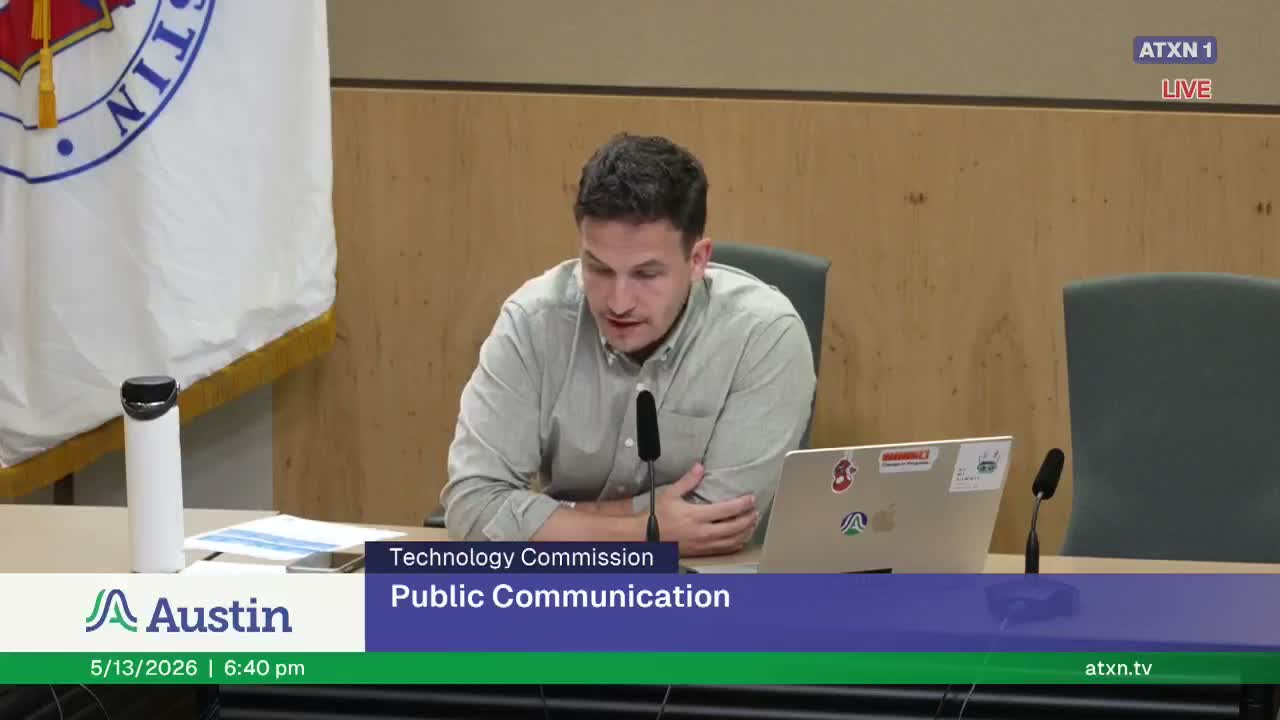
Austin Technology Commission approves strengthened data‑center recommendations including decommissioning bond and disclosure requirements
Summary
The Technology Commission voted unanimously May 13 to forward a package of recommendations to City Council that would require large data centers to disclose projected and actual water use, aim for at least 50% grid‑consumption offsets, add enforcement language on fines, and require a decommissioning bond to mitigate stranded‑asset risk.
The City of Austin Technology Commission voted unanimously May 13 to adopt a modified set of recommendations for large data‑center development and to forward the package to City Council.
The package, developed by the commission's artificial‑intelligence and public‑surveillance working groups and revised during Thursday's meeting, adds several enforcement and community‑protection measures to an existing set of guidelines. Key changes include mandatory disclosure of projected and actual water use for large facilities, a target that at least 50% of a facility's grid consumption be offset by renewable sources, language directing the city to pursue rules with "fines of sufficient magnitude," and a new requirement that developers post a decommissioning bond sized to cover site remediation and community mitigation costs.
"If there are not fines of sufficient magnitude to constitute an existential risk to any company building or running a data center, then violating our regulations and paying these fines will merely be seen as the cost of doing business," Kevin Welch, president of the board at EFF Austin, told the commission. Welch urged the commission to ensure enforcement mechanisms are meaningful and to consider limits on tax incentives for centers used for surveillance purposes.
The commission discussed technical and policy background for the recommendations before the vote. Dr. Ning Lin of the University of Texas Bureau of Economic Geology's Compass program presented research and tools the commission used as background, describing a geospatial suitability heat map and a set of white papers on permitting, water use and on‑site generation. "Currently, there are over 400 data centers in Texas," Dr. Lin said, and his team emphasized that the interconnection queue and permitting timelines — especially power interconnection through ERCOT — are the longest steps in many projects.
Commissioners debated narrower approaches to water policy. One commissioner objected to singling out data centers for tiered water rates, recommending instead that any water‑use policy be applied more broadly to large commercial and industrial users; commissioners agreed to narrow language accordingly and to remove stand‑alone water‑tier mandates from the recommendation. The decommissioning bond amendment, read into the record by Chair Stephen Apodaca, would require a bond triggered by "operational abandonment" defined as 12 consecutive months during which a facility fails to maintain at least 20% of its projected utility load or 20% of its committed staffing levels, as verified by annual independent audits. Under the amendment, bond proceeds in the event of abandonment or insolvency would be redirected to a locally certified community development financial institution (CDFI) to support digital equity, workforce development or neighborhood revitalization within Austin.
"Austin must require full disclosure of the actual parent company and any other ongoing contracts being negotiated before any permanent incentive or agreement moves forward," Neha Shah, speaking as a private citizen and technology professional, added during public comment. Shah also urged clearer job‑outcome commitments and cited international examples where early renewable thresholds, mandatory reporting and penalties are used to align industry growth with public goals.
After brief final remarks and a voice vote, Chair Apodaca declared the motion to adopt the modified recommendation unanimous and said the commission would forward the document to City Council. The transcript records commissioners voicing "aye" and the chair's declaration of unanimity; an explicit roll‑call tally naming each commissioner was not recorded in the meeting transcript.
The commission then resumed other agenda items, heard an update from G5R (gFiber) on broadband expansion and digital inclusion programs, and later recessed when quorum was lost.
What happens next: the Technology Commission will send the recommendation packet, including the newly added enforcement and bond language, to the Austin City Council for consideration. Council staff and legal review will be required to convert the commission recommendations into any enforceable ordinance or rule. The commission noted it will continue to engage stakeholders and refine language as Council and staff review the package.