Get Full Government Meeting Transcripts, Videos, & Alerts Forever!
Get email alerts on the Alcohol Regulation topic
No spam. Unsubscribe anytime.
Arlington board keeps beer privilege tax at $100 and adopts beer ordinance; liquor permit changes draw public comment and zoning questions
Summary
The board approved changes to beer sales rules, keeping the privilege tax at $100, and held a public hearing on a liquor‑sales ordinance; a local liquor‑store owner urged a lottery for permits, a ban on check‑cashing, and deadlines for opening, while staff explained conditional‑use review and a temporary vape‑store moratorium.
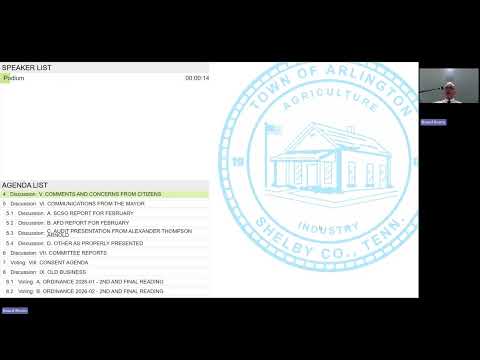
The Arlington Board of Mayor and Aldermen on March 3 approved a second and final reading of an ordinance amending beer‑sale provisions and kept the proposed privilege tax at $100 rather than $250, a change staff said was made between the first and second readings.
"There has been a change between first and second reading, and that only change is that instead of proposing the 250 for the privilege tax, we're gonna keep it at a 100," said Owens, a city staff member, and staff recommended approval. No members of the public spoke for or against the beer ordinance during the public hearing, and the board adopted the ordinance by vote.
The board then took up a second and final reading of an ordinance to amend rules for the sale of liquor within town limits and opened a public hearing. Patrick Dorian of Old Town Wine and Liquors LLC spoke during the hearing and urged the board to establish a transparent selection process if it awards a new permit. "I'd like to ask the board to consider a lottery approach for the awarding for the other permit, for the sake of transparency," Dorian said. He also asked the board to consider restrictions that would bar check‑cashing services and limit vape products in a new liquor permit, and proposed thresholds — for example, 90 days to finalize purchase or opening — to avoid permits being banked without action.
During discussion, one board member said he favored extending the 1,500‑foot spacing from an existing liquor store because he did not want two liquor stores concentrated on Highway 70. Board members asked whether the town could legally prohibit ancillary services such as check‑cashing or require a liquor‑only use. Jeremy, a staff member, said the process in front of the board is a conditional‑use pathway: even if a permit is approved, applicants must submit a site plan and go before the Board of Zoning Appeals and the planning commission, and additional reasonable conditions can be imposed there.
Jeremy also noted that the town has enacted a temporary moratorium on new vape stores so staff can study state regulations and the Alcoholic Beverage Commission's recent actions related to synthetic products. "There is a vape store moratorium so that we can study," he said, adding that state ABC rules also affect some categories of products.
What happens next: the beer ordinance has cleared second and final reading and will be enacted as adopted; the liquor‑sales ordinance completed a public hearing and remains subject to the conditional‑use process and any ordinance adoption or further board action pending formal vote (no final vote on the liquor ordinance was recorded in the provided transcript).