Get Full Government Meeting Transcripts, Videos, & Alerts Forever!
Get email alerts on the Archives topic
No spam. Unsubscribe anytime.
Washington County archivist spotlights 1771 records, a short-lived "republic" and genealogy projects
Summary
Donna, the Washington County archivist, told a Brown Bag audience that the county holds continuous records back to 1771, described a Civil War-era District 2 secession sometimes named in the transcript as Bricher's/Bicker's/Bricker's Republic, and promoted the archives' online holdings and genealogical services.
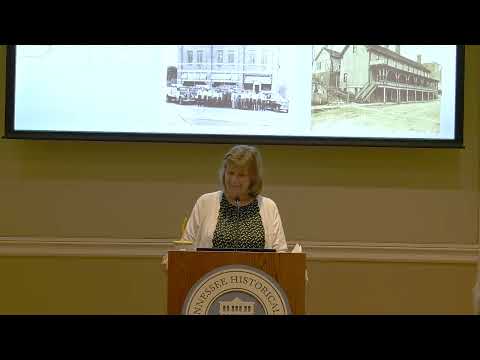
Donna, the archivist for Washington County, told attendees at an East Tennessee Historical Society Brown Bag on June 17 that the county's archives include continuous records dating to 1771 and that staff are actively scanning and posting material online.
"We have the oldest records in the state of Tennessee and we are very proud of that fact," Donna said, describing two storage locations in Jonesborough (the office and a renovated old jail) and a records-fee funding model that adds roughly a $5 surcharge to some county record transactions to support archive operations and staff.
The presentation highlighted a range of material in the holdings: marriage licenses and wills (Donna said those are posted "up to 1800"), tax lists, chancery court plats, hand-drawn maps, and more than two dozen documents bearing Andrew Jackson's signature, including one handwritten book attributed to him. Donna said the archives recovered a deed book returned from Nashville in 2021 and that the first pages of that book document a land agreement with Cherokee signatories.
She also read from and discussed local Civil War-era records recounting a small area of Washington County that briefly declared itself independent from Tennessee following the state's 1861 secession vote. The transcript shows several variant spellings of that district's nickname; Donna read contemporaneous letters the group sent to newspapers and described the episode as a localized protest that quickly dissipated after a failed attempt to press the matter in Washington, D.C.
"They said, 'we ain't gonna do it,'" Donna recounted, reading a period letter that framed the district's actions as an effort to "defend, maintain, and rigidly enforce" local rights. The archive's holdings include voter forms and district lists that Donna showed to attendees to illustrate how different parts of Washington County voted in 1861.
Donna also described the archives' "early landowners" project: volunteers and a local deed specialist map early deed entries onto modern basemaps, assemble short biographical sketches from wills and tax lists, and link those reconstructions to digitized records. She recounted the research that verified Revolutionary War veteran Hugh Harris's long life and service and noted that, after archival work, the Daughters of the American Revolution placed a more durable marker at his grave.
The archivist emphasized the archives' work with visiting researchers and community members, including an English researcher, Robert Wells, who has photographed thousands of records; she described giving descendants small mementos such as soil collected from ancestral parcels during onsite visits.
Donna closed by urging visitors to consult the archives' website and Facebook page; she said the archives has more than 2,000 followers on Facebook and that some posts have exceeded 10,000 views. During a question-and-answer period, she said Sullivan County is a "burned county" with few pre-1860 records, confirmed the identity of a local researcher in the audience, and outlined the archives' usual research assistance (staff will pull tax lists, court cases and other guides and ask researchers to provide surnames and date ranges in advance).
The presentation ran informally as part of the East Tennessee Historical Society Brown Bag Series and concluded with an invitation to consult the archives' online resources for scans and further guidance on genealogical research.