Get Full Government Meeting Transcripts, Videos, & Alerts Forever!
Get email alerts on the State Legislation topic
No spam. Unsubscribe anytime.
Norfolk official outlines state bills, budget priorities and a planned closed session
Summary
Brian Pennington, the city's director of government relations, briefed council on Norfolk'requested legislative items and budget amendments — including a proposed non-federal match fund for flood mitigation (referred back to subcommittee), consolidation of state bottomlands authorizations (estimated $2,000,000 annual savings), city-charter zoning fixes (SB 305/HB 147), CFPF loan interest deferment (SB 197), and a pending closed-session vote on contracts, leases and appointments under Virginia FOIA.
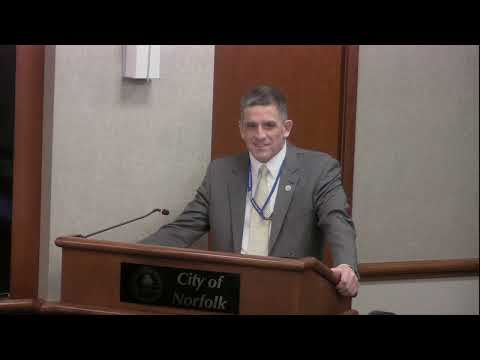
Brian Pennington, the City of Norfolk's director of government relations, gave a wide-ranging update on state legislation and competing budget proposals at the council work session, emphasizing flood mitigation, property-authority fixes and several budget amendments that could affect Norfolk.
Pennington said the city's top priority this session was creation of a non-federal match fund for flood mitigation projects. That proposal did not advance in the Senate Finance Committee and was referred back to a subcommittee; Pennington said the city will continue to press the issue and noted possible site visits by subcommittee members to Norfolk projects.
He described legislation addressing state-owned bottomlands as an important, although "paperwork"-focused, change intended to consolidate more than 100 individual easements into a single authorization for specific Norfolk waterfront projects. Pennington estimated the streamlining could save "up to $2,000,000 a year" in staff time and transactional costs, and said the change would not alter federal environmental permitting requirements.
Pennington flagged SB 305 (patron Senator Williams Graves) and companion HB 147 on city-charter and zoning designations; both measures had passed and, he said, appear likely to be approved by the governor. He also discussed SB 197, a measure to defer interest and repayment requirements on CFPF loans, and credited local work that helped push that item forward.
A rental-utilities bill carried by Delegate Anthony, intended to help tenants who lack separate utility accounts access certain programs, cleared the House on a party-line vote and was scheduled for a Senate general laws hearing the next day; Pennington said he planned to testify with partner cities and organizations.
On budget matters, Pennington said the Senate proposed ending a data-center sales-tax exemption (a change with large revenue implications) while increasing rebates, protecting Medicaid funding where possible, and proposing a teacher pay increase that would not require a local match. He also noted a $50 million budget amendment for affordable housing and additional appropriations for K'12 and workforce development in varying amounts between the chambers.
Pennington said two cannabis-regulatory bills (HB 642 and SB 542) have passed and will go to conference; he said the bills do not create a local licensing "checkoff" but leave open questions about local authority and how sales tax might be shared with host localities. He warned that proposed Internet gaming legislation, as introduced, did not contemplate revenue sharing with local host governments and said the city is engaging patrons on that issue.
Pennington told council the House had proposed a local-option voter referendum for a 1% sales tax to fund school construction (HB 334); the measure would permit up to 1% if approved by voters and the city-attorney's office had identified Maury High School as an eligible project. He also called attention to SB 454 (patron Van Valkenburg), a substitute bill intended to incentivize affordable housing but which, as introduced, raises concerns about the taking of local authority; the city and local government associations are opposed to the bill in its current form.
Near the end of the briefing, the chair announced four constitutional amendments will be on ballots this year (one on an April special ballot related to redistricting and three on the November general election covering automatic restoration of voting rights, marriage equality and reproductive-rights language). Pennington warned that some election-administration changes could create unfunded staffing and reporting requirements for the city.
The council then moved and voted to hold a closed-session meeting under Virginia FOIA §2.2-3711 to discuss contract matters for city-owned property, board and commission appointments, and a lease-amendment matter. A roll call recorded affirmatives from the councilmembers listed.