Get Full Government Meeting Transcripts, Videos, & Alerts Forever!
Get email alerts on the Education topic
No spam. Unsubscribe anytime.
Pasco School Board reviews annual objectives as superintendent reports literacy gains and implementation steps
Summary
At a study session the Pasco School Board reviewed district objectives and a measurement framework; Superintendent Whitney reported an almost 6% increase in reading proficiency, movement of more than 1,600 students out of emergency literacy status, and an implementation plan for MTSS while outlining a June 30 deadline for the superintendent evaluation.
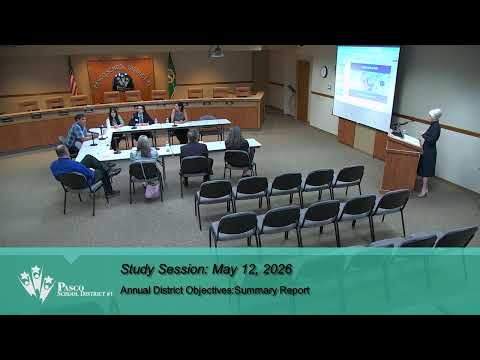
The Pasco School Board of Directors met in a study session to review progress on the board’s annual objectives and the district’s system for measuring student improvement. Board President Lerman opened the session and introduced Superintendent Whitney, who presented results and next steps for monitoring and supporting student outcomes.
Superintendent Whitney said the district has adopted a "tiered significance" model to distinguish meaningful change from normal fluctuation and to better align evidence to the board’s strategic plan and the superintendent evaluation. "We saw an almost 6% increase in reading proficiency," Whitney said, noting the rise produced a four‑year high in proficiency and that "nearly 700 students gained proficiency from grades 2 to 8." She added that more than 1,600 students in grades K–5 moved out of emergency literacy status.
The presentation described work to build consistency across 27 buildings through a strengthened Multi‑Tiered System of Supports (MTSS). Whitney said the district completed an outside audit by AIR, updated policies, developed an MTSS handbook, and partnered with OSPI and the University of Washington through the Last Mile Project to integrate academics and social‑emotional learning.
On assessments and interventions, Whitney said embedded literacy measures (named in the presentation as IRRRLIN and NEAL) showed statistically significant growth across grade levels, with kindergarten demonstrating especially strong gains. She cautioned that results for acceleration and intervention were mixed: "Some cohorts will require additional focus," she said, and the monitoring system is intended to highlight where refinements are needed.
Staff framed curriculum implementation as a key lever: literacy materials are in their fifth year of implementation, while new mathematics materials are in their first year. Whitney said the district expects to replicate the literacy approach—new curriculum combined with coaching and fidelity of implementation—to drive stronger math outcomes, noting that algebra completion rates have improved and the class of 2026 shows the highest passage rates so far.
Whitney also emphasized the role of early learning. "Students who attend pre‑K consistently outperform peers who did not," she said, and cited a strong correlation between preschool attendance and later math proficiency.
The presentation tied these findings to board governance and timing: Whitney asked board members to engage with the evaluation process and be responsive to materials shared by the evaluator so the superintendent’s final evaluation can be completed by the contractual deadline. "The final evaluation of the superintendent is contractually required by June 30," she said, and outlined a plan to centralize evidence to support board ratings.
During Q&A, a board member asked when next year’s goals would be developed. The board discussed producing a draft strategic improvement plan before the June meetings, using a July retreat (typically the fourth Tuesday) or a July study session for goal‑setting, and finalizing objectives at the last board meeting in August per policy.
The study session closed with the board agreeing to use the centralized materials for the superintendent evaluation, to aim for evaluation completion before June 30, and to hold a July planning session for next year’s goals.