Get Full Government Meeting Transcripts, Videos, & Alerts Forever!
Get email alerts on the Alcohol Policy topic
No spam. Unsubscribe anytime.
Arlington board adopts tighter liquor rules, adds lottery for new permit and keeps beer tax at $100
Summary
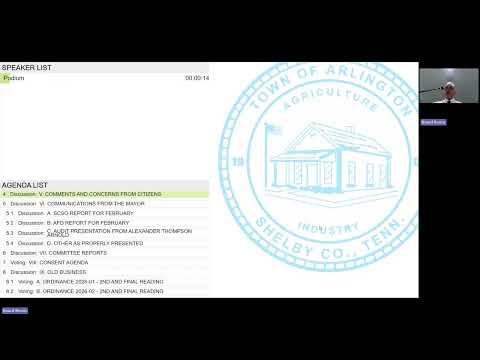
At its March 3 meeting the Arlington Board approved two alcohol-related ordinances: a second reading keeping the beer privilege tax at $100 and a revised liquor ordinance that adds public-building buffers, expands separation distance from existing stores and establishes a public lottery and timelines for awarding a new liquor permit.
The Arlington Board of Mayor and Aldermen on March 3 approved changes to local alcohol rules that will keep the beer privilege tax at $100 and create a structured process for awarding a new packaged‑liquor permit.
At a second and final reading of Ordinance 2026‑O1, staff recommended—and the board approved—keeping the privilege tax at $100 rather than the $250 that was discussed earlier in the drafting process. Mrs. Owens, a town staff member, told the board the change from first reading was limited to the tax amount and recommended approval.
The session’s more extensive debate concerned Ordinance 2026‑O2, the second and final reading governing packaged‑liquor sales. The board held a public hearing; Patrick Dorian, who identified himself as a representative of Old Town Wine and Liquors LLC, urged a transparent lottery process for awarding the new permit, recommended limiting check‑cashing services and suggested a 90‑day threshold to complete a property purchase after permit award. “I’d like to ask the board to consider a lottery approach for the awarding for the other permit, for the sake of transparency,” Dorian said.
Board members discussed zoning and conditional‑use protections, whether the town can limit ancillary services at a package store, and the distance required between an existing store and a new permit. Town staff explained the authorization is a conditional‑use process that also requires a site plan, planning‑commission review and board of zoning appeals action; staff advised that some restrictions would be applied through those processes.
A procedural amendment to expand the list of nearby facilities that trigger a 500‑foot exclusion passed by voice vote. The amendment added fire stations, police/sheriff stations, the post office and town hall to the ordinance’s existing list (which already included libraries, parks, schools and churches).
Another amendment proposed changing the separation from an existing liquor store from 1,500 feet to 2,500 feet; that amendment passed by a recorded 5–2 vote. The board later adopted the overall ordinance (as amended) on final reading. Staff described the next steps if the ordinance is adopted as written: publish application dates for a short period, accept and vet applicants, then hold a public lottery to select qualified applicants; the town would then issue a certificate of compliance that a prospective licensee must present when applying to the state.
Town staff also explained applicant timelines and limits: the certificate of compliance requires an applicant to submit to the state; the town allows up to 180 calendar days for applicants to progress toward state approval and has follow‑up processes (including a three‑year limit to begin construction) to prevent indefinite holding of permits.
The changes clear the way for staff to publish an application window (staff suggested April to May timelines) and host a public drawing in May or June once applicants meet the town’s vetting standards.
Votes at a glance: Ordinance 2026‑O1 (sale of beer privilege tax kept at $100) — approved unanimously; Ordinance 2026‑O2 (sale of liquor, as amended) — amendments adopted (500‑foot facility additions by voice vote; separation increase to 2,500 feet 5–2) and the ordinance approved on final reading.
The board signaled staff would publish application dates and follow the conditional‑use and site‑plan processes before any certificate of compliance is issued.