Get Full Government Meeting Transcripts, Videos, & Alerts Forever!
Get email alerts on the SF4787 Ad Tax topic
No spam. Unsubscribe anytime.
Senate Taxes Committee hears wide-ranging testimony on bill to tax advertising services; A2 amendment adopted and bill laid over
Summary
Supporters said Senate File 4787 would modernize the sales-tax base and raise revenue for state services; opponents warned it would tax business inputs, risk litigation under internet-tax rules, and harm small businesses and local news. The committee adopted an A2 author’s amendment and laid the bill over.
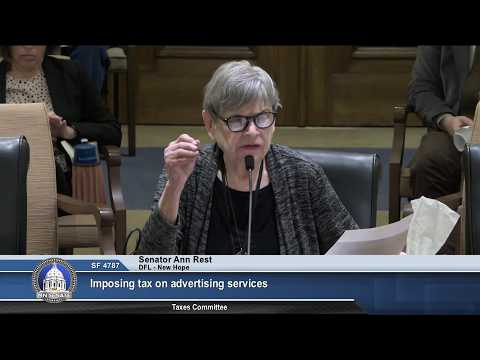
The Minnesota Senate Taxes Committee on April 8 took testimony on Senate File 4787, a bill that would expand the state sales tax to include certain advertising services and exempt print, radio and television advertising. After testimony from business groups, labor and small-business owners, the committee adopted an author’s amendment (A2) and laid the bill over for further consideration.
Eric Bernstein, director of the We Make Minnesota coalition, testified in support, saying the bill modernizes the sales-tax base to reflect a service- and digital-focused economy, would reduce preferential tax treatment for large digital platforms and would raise revenue while allowing a modest reduction in the headline sales-tax rate. Bernstein stated the proposal would ‘‘raise $300 million’’ in messaging to the committee and emphasized the distributional fairness argument for broadening the base.
Opponents argued the proposal would tax business inputs, raise operating costs for Minnesota employers and expose the state to legal risk. Brian Cook, director of tax and fiscal policy for the Minnesota Chamber of Commerce, said the measure would be subject to litigation under the Internet Tax Freedom Act and commerce-clause questions and warned that, as a sales tax, any cost ultimately could be passed to Minnesota consumers. Paul Eger of the Minnesota Realtors Association said many real-estate agents are independent contractors who rely on advertising tools (multiple-listing services, online promotions, photo and video editing) and that taxing those services would hit new and small brokers disproportionately.
Other witnesses included Deb Peters (Americans for Digital Opportunity/Internet Coalition), Dalton Danielson (Minnesota Business Partnership), Tanner Fritsinger (Minnesota Association of Professional Employees, supporting the bill), teacher Kirsten Morcomb (supporting the bill for education funding), Jon Boesche (NFIB, opposing) and Timothy Otte (Wild Rumpus Books, supporting). Testimony touched on small-business impacts, local-news revenue concerns and litigation risk for taxes that affect cross-border digital transactions.
Committee members recited Department of Revenue revenue estimates into the record. The chair and fiscal staff described a FY2027 rate-reduction cost of roughly $104 million and a FY2027 base-broadening impact of about $183 million. For full fiscal years 2028–29 the department’s figures cited in committee described the base broadening as nearly $600 million and the proposed sales-tax rate reduction as reducing revenue by about $300 million; the chair attributed those numbers to the Department of Revenue’s revenue estimate. Committee discussion highlighted that the bill, as drafted, functions in part as a tax on business inputs rather than solely a final-consumer tax and that such a structure raises concerns about pyramiding, competitiveness and legal exposure.
Sen. Rest introduced and the committee adopted an A2 author’s amendment (voice vote) that clarifies definitions and narrows certain impacts; the committee then laid Senate File 4787, as amended, over for future consideration. The committee also moved later to adopt an authors’ amendment on Senate File 4690 and laid that bill over as amended before adjourning.
No roll-call votes were recorded on the revenue or policy questions during this hearing; members asked the department and fiscal staff for further information as they consider next steps.