Get Full Government Meeting Transcripts, Videos, & Alerts Forever!
Get email alerts on the Land Use topic
No spam. Unsubscribe anytime.
Plymouth ZBA continues hearing on proposed LP Gas bulk‑storage after residents raise watershed, safety and design concerns
Summary
The Plymouth Zoning Board of Adjustment continued a special exception public hearing for a proposed non‑public LP Gas (propane) bulk‑storage facility after residents and board members urged more information on environmental risk, emergency response and design; the applicant will return May 5 with additional studies and renderings.
A special exception public hearing on a proposed non‑public bulk propane storage facility on parcel 213‑028 in Plymouth’s agricultural zone was continued to the ZBA’s May 5 meeting after the board and nearby residents pressed the applicant for more information.
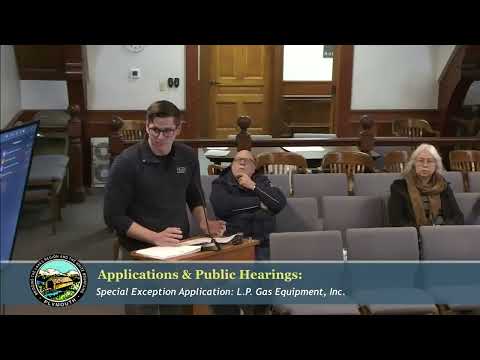
The applicant, represented by Aaron Lamar of HEB Engineers, described a low‑service facility for Eastern Propane with two large tanks, a small driver room and a circular access designed for WB‑67 delivery vehicles. "My name's Aaron Lamar and with HEB Engineers here representing LP Gas Equipment Inc. and ultimately Eastern Propane who's going to be the operator for this," Lamar told the board, adding the site would not be open to the public and utilities would be underground.
Why it matters: Residents said the site’s proximity to the Baker River, local irrigation intakes and a town beach raises potential environmental and public‑health risks if a spill occurs. Multiple speakers urged the board to require a transparent environmental and emergency‑response risk assessment and clearer operational limits before the board moves forward.
During the board’s question period members asked whether the applicant would need a DOT driveway permit and shoreline approvals; Lamar acknowledged both were anticipated and said the project would include stormwater infiltration and planned plantings. Neighbors and nearby property owners pressed for specifics on tank dimensions, truck frequency and hours of operation. Resident John Dockery said he was "neutral" but worried about scale and visibility, and asked how large the tanks would be; Lamar estimated dimensions of roughly 12 by 60 feet and "maybe 15 ft tall."
Several residents objected during public comment. Alfie Kerr said he supported requiring a "comprehensive and transparent risk assessment including environmental and emergency response impacts" before further consideration. Nate Everts, who farms across the river, said runoff or spillage could affect an irrigation pump that supplies produce sold locally. Susan Matheson said the application lacked precision and asked for photo renderings, exact truck counts and operating days/hours to judge compatibility with the Tenney Mountain corridor.
Board deliberations emphasized information gaps. The ZBA noted no independent studies of spill or catastrophic incidents had been provided and that the fire department had submitted no specific comments in the packet. The board listed factual findings including parcel size (about 4.31 acres), proposed build area (~26.7% of the lot) and that the use is allowed by special exception in the agricultural zone, but identified unanswered items the board considered necessary to apply the special‑exception criteria: on‑site fire mitigation and emergency equipment, concrete truck frequency and operating hours, security/fencing details, screening/renderings, and a risk assessment addressing potential impacts to the Baker River watershed.
At the applicant’s request the ZBA voted to continue the hearing to May 5 so the applicant can provide the additional materials the board requested. Aaron Lamar told the board he would return with the requested documentation and security/fencing plans.
What happens next: The applicant will supply risk‑assessment information, any available fire‑safety/security plans, clearer hours of operation and truck counts, and photo renderings or visualizations for the board and the public to review at the May 5 meeting. The hearing remains open until that date.