Get Full Government Meeting Transcripts, Videos, & Alerts Forever!
Get email alerts on the Gun Violence Prevention topic
No spam. Unsubscribe anytime.
Committee hears testimony on creating a state Office of Gun Violence Prevention; bill laid over
Summary
The Minnesota House Finance and Policy Committee heard hours of testimony for and against HF 3668, a proposal to create a state Office of Gun Violence Prevention; proponents framed gun violence as a public-health crisis and opponents warned of politicization and added bureaucracy. The bill was laid over for further work.
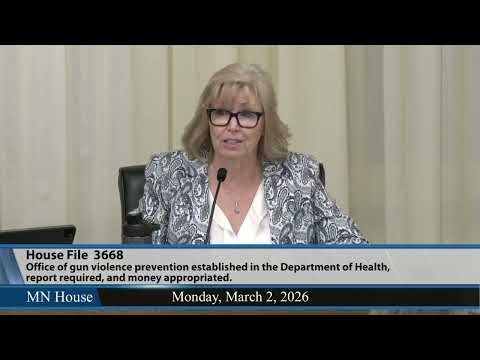
The House Finance and Policy Committee on March 2 heard extensive testimony on House File 3668, a bill to create a permanent Office of Gun Violence Prevention in Minnesota that supporters said would centralize research, data and prevention efforts and opponents said could politicize firearm policy.
Supporters told the committee the measure would treat firearm injury as a public-health problem requiring sustained coordination. "Gun violence is the leading cause of death for children and adolescents in the United States," the bill sponsor said in opening remarks, urging the committee to "choose action over paralysis." Dr. Lisa Matson, president of the Minnesota Medical Association, told members that "more than 500 Minnesotans died by firearms each year" (Minnesota Department of Health data cited) and urged stable infrastructure for data collection and analysis.
Advocates said the office would bring clinicians, researchers, law enforcement and community groups together to identify what works and scale proven interventions. Maggie Emory of Protect Minnesota said Minnesota's gun-death rate rose 35% from 2014 to 2023 and argued the state lacks a centralized mechanism to marshal information and evaluate programs. Trish Toit, an assistant professor at the University of Minnesota School of Public Health, described local pilot projects such as voluntary out-of-home firearm storage and urged that funding and coordination reach all communities.
Opponents questioned whether the office would be an appropriate use of taxpayer funds and warned it could be used to reshape firearms policy. "Minnesota does not need another layer of government bureaucracy focused on reframing and restricting a constitutional right," said Anna Lee, who identified her role in the record as a director of government relations and advocacy for a caucus, and urged focusing on enforcing laws and prosecuting violent offenders instead.
Committee members probed practical details: whether the proposed office duplicates existing programs, how many staff it would employ and how much it would cost. The bill author said an amendment would add fiscal specifics but offered an initial staffing estimate of roughly three full-time positions (a director, an epidemiologist and an associate director) to start and said the office's earliest work would be timely data collection and coordination across state, local and community partners.
Several lawmakers emphasized that preventing gun violence intersects with mental-health services, school safety and victim services. Dr. Katherine Diamond of the Minnesota Department of Health said a public-health approach focuses on root causes and protective factors and can complement Department of Public Safety efforts rather than duplicate them.
The committee did not hold a final vote on HF 3668. The chair "renewed the motion" to lay the bill over, and the measure was laid over for possible inclusion in an omnibus bill, with a fiscal note requested and further work promised on amendment language.
Next steps: committee members asked for a fiscal note and for the author to return with clearer staffing and budget language and any proposed technical amendments.