Get Full Government Meeting Transcripts, Videos, & Alerts Forever!
Get email alerts on the Defense Technology topic
No spam. Unsubscribe anytime.
DARPA outlines CyPhER Forge to speed combat-systems testing using digital twins and AI
Summary
Colonel James Valpiani of DARPA described CyPhER Forge, which pairs faster-than-real-time physics-informed digital twins with AI test agents. He said the goal is to accelerate testing 'by an order of magnitude' and improve safety, listing six core enabling technologies.
Colonel James Valpiani, a program manager at the Defense Advanced Research Projects Agency (DARPA) and chief of combat autonomy for the Air Force Test Center, outlined a new DARPA effort called CyPhER Forge to accelerate testing of complex combat systems.
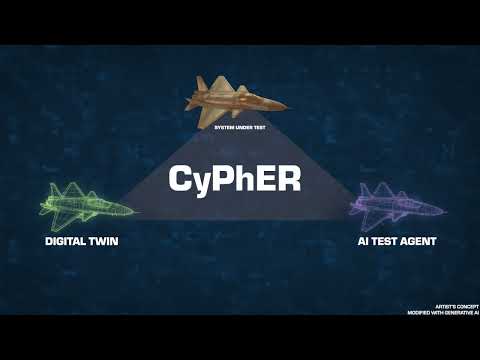
"CyPhER Forge stands for Cyber-Physical systems Executing in Real time," Valpiani said, adding that the program’s objective is "to accelerate the pace at which we test complex combat systems by an order of magnitude" through two main innovations.
The first innovation, he said, is physics-informed digital twins that can execute faster than real time and merge physics modeling with empirical test data while quantifying uncertainty. The second is AI test agents that reason over the digital twin and environmental constraints to identify maneuvers that are both "knowledge maximizing" and "statistically safe," then direct the system under test.
Valpiani listed six core technologies underpinning the approach: three aimed at the digital twin—physics-informed surrogate modeling, uncertainty quantification and data assimilation—and three for the AI test agent—knowledge maximization, statistically guaranteed safety assurances, and agentic artificial intelligence capable of end-to-end planning and execution.
He described the testing cycle as a closed loop: the digital twin predicts engineering quantities of interest with uncertainty; the AI agent selects and directs maneuvers consistent with user constraints; the system under test executes them with machine precision; and new sensor data flows back into the digital twin for continuous assimilation.
Valpiani tied the program to recent advances in computing and machine learning, saying cheaper high-performance compute and abundant data make it possible to treat a well-calibrated digital twin as a practical "truth source." He said, if successful, a CyPhER could allow test professionals to field capabilities to warfighters more quickly and with greater safety margins than current methods.
Valpiani also described how his prior roles as a flight tester and Commandant at the Test Pilot School influenced the program’s design and aims. He framed CyPhER Forge as an opportunity to address long-standing trade-offs in testing—speed, rigor and safety—without offering a detailed timeline or funding breakdown during the remarks.
The briefing did not include formal actions, votes or a specified fielding schedule.