Get Full Government Meeting Transcripts, Videos, & Alerts Forever!
Get email alerts on the Aerospace Aviation topic
No spam. Unsubscribe anytime.
DARPA announces $6.5 million Lift Challenge to boost drones' payload-to-weight ratios
Summary
DARPA program manager Phillip Smith announced the Lift Challenge, a competition offering $6.5 million in prizes to spur drone designs that carry at least 110 pounds while keeping vehicle weight under 55 pounds; competitors must meet FAA and experimental airworthiness rules and complete a 5-nautical-mile course in under 30 minutes.
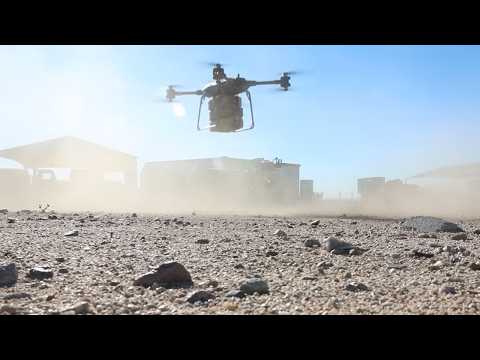
Phillip Smith, a program manager at the Defense Advanced Research Projects Agency (DARPA), announced the DARPA Lift Challenge, a competition intended to accelerate designs that increase vertical-lift drones' payload-to-weight ratios.
"We’re going to host a drone competition next summer, with $6.5 million in prizes," Smith said, calling on garage inventors, businesses and university aeronautical programs to participate.
DARPA described the problem the contest seeks to address: Smith said today’s multirotor drones often operate at payload-to-weight ratios of about 1:1 or less, which forces larger, more expensive aircraft as payload demands grow. "With the Lift Challenge, our goal is to dramatically increase the useful load which will then drive down the cost per pound of transported cargo," he said.
The agency set explicit vehicle requirements to make entries comparable. DARPA said the heavier-than-air aircraft, plus all of its components excluding the payload, must weigh less than 55 pounds and be capable of non-assisted vertical takeoff and landing. The competition will use commercially available Olympic barbell gym plates as the standardized payload.
The course is a circuit-style, 5-nautical-mile route flown at 350 feet. Competitors must carry the payload for 4 nautical miles, drop it off, then fly the final mile unloaded. To post a qualifying run a vehicle must carry a minimum payload of 110 pounds and complete the course in under 30 minutes. Scoring is based on the highest payload-to-weight ratio at the end of the course.
DARPA said the rules are posted in draft form on its website and were designed with FAA regulations in mind. Smith said competitors will need FAA Part 107 certification, an experimental airworthiness certificate and a commercial drone license to be eligible for prize money.
"We’ve designed [the rules] to ensure maximum participation as well keeping safety and compliance," Smith said, and invited public input on the draft rules via DARPA.mil. He urged teams to begin design and flight testing soon because of the fast timeline.
DARPA framed the challenge as a way to unlock new capabilities for sectors such as agriculture, construction and logistics if competitors can deliver higher payload-to-weight ratios. The agency did not specify exact program phases, deadlines for final rule publication, or the exact prize breakdown among winners.
Interested teams can sign up for email updates and review the draft rules at DARPA.mil. DARPA said more information will be released as it finalizes the competition schedule.