Get Full Government Meeting Transcripts, Videos, & Alerts Forever!
Get email alerts on the Park Master Plan topic
No spam. Unsubscribe anytime.
Cape Coral City presents two park master‑plan concepts and seeks public input
Summary
Consultants and Cape Coral City staff previewed two conceptual master‑plan alternatives for a large former golf‑course site, highlighted seven guiding principles and a 10% impervious‑surface target, and invited public feedback while a parallel stormwater study is completed.
Consultants and Parks & Recreation staff presented two concept alternatives for redeveloping a large, formerly golf‑course parcel in Cape Coral City and asked residents to weigh in as a separate stormwater study is finalized.
Joe Petrillo, Cape Coral Parks and Recreation director, opened the forum and said the designs are conceptual and intended to narrow public preferences into one deliverable plan. "These are conceptual designs to get us down to one design that meets the public's need," he said, and invited attendees to submit comments in person or via an online survey.
Rachel Carter, a landscape architect with the consultant team, summarized an extensive engagement program that began in October and included a public meeting, online and paper surveys, staff and stakeholder interviews, and a design charrette. She said the team developed two alternatives — called "Anchor" and "Drift" — that reflect differing ways to organize program elements across the site while honoring public priorities.
The Anchor concept concentrates activity in a central hub with a community/nature center, small amphitheater, centralized parking and radiating multi‑use trails, leaving farther reaches as passive natural areas. The Drift concept spreads program nodes across the site with light‑touch roads and multiple access points; one node could offer a low‑impact "golf experience" designed to meet environmental standards the team described.
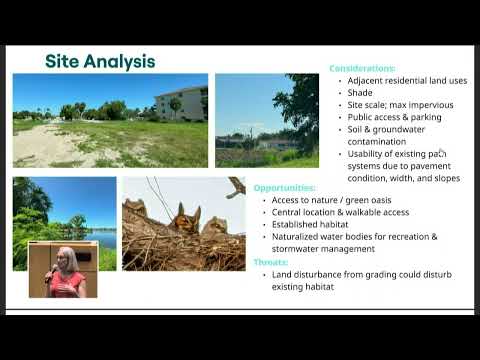
Consultants said engagement results showed consistent recreation priorities (walking, biking and trails), environmental priorities (wildlife habitat and native plantings) and amenity requests (shade, comfort stations, community gardens and play spaces). "We heard an overwhelming amount of desire for this to be a natural space to limit impervious," Carter said.
The team presented seven guiding principles to apply across both plans, including safe public access, flood relief, improved water quality, constructed ecologies that preserve habitat, and limits on impervious surfaces. Carter said the team has proposed a 10% maximum impervious surface to reduce pavement and roofed areas on the site.
Next steps: the consultants will take written feedback from comment cards and the online Social Pinpoint site, coordinate with the stormwater team to reconcile technical requirements, and return in the fall with a refined single master‑plan concept for final review and adoption.