Get Full Government Meeting Transcripts, Videos, & Alerts Forever!
Get email alerts on the Nurse Staffing topic
No spam. Unsubscribe anytime.
NHSN explains new Nurse Staffing Hours Indicator for critical care units; reporting is voluntary
Summary
In a 30-minute NHSN training, a presenter outlined the Nurse Staffing Hours Indicator, who to include/exclude in nurse-hour counts, how to report monthly via NHSN (manual or CSV), and basic analysis steps; reporting is voluntary and the indicator currently covers critical care units.
A presenter for the National Healthcare Safety Network (NHSN) outlined the new Nurse Staffing Hours Indicator and how acute-care hospitals should report nurse hours from critical care units.
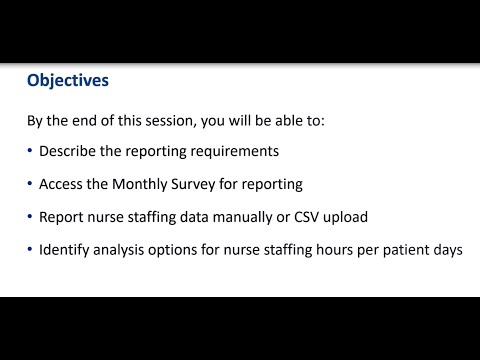
The presenter said the 30-minute session aimed to teach facilities how to describe reporting requirements, access and use the Monthly Survey in NHSN, choose between manual entry and CSV upload, and run basic NHSN analyses. "This is voluntary reporting," the presenter said, and participants were told facilities must be enrolled in NHSN and have critical care units mapped in NHSN to submit data.
Why it matters: nurse staffing levels are a core measure of hospital capacity and patient care. The presenter noted that registered nurses number nearly 4.7 million nationally, LPNs/LVNs almost 658,000, and nursing assistants/orderlies about 1.5 million — figures offered to contextualize why standardized reporting is useful for comparison and analysis.
Who and what to count: The presenter defined which workers to include in nurse-hour counts and which to exclude. Count registered nurses (RNs), LPNs/LVNs and unlicensed assistive personnel (UAP) who are assigned to and actually working on the critical care unit, including temporary or contract staff charged to that unit. Exclude advanced practice registered nurses working in provider roles, staff with primarily administrative responsibilities, specialty teams not assigned to the unit, unit secretaries, clerks, schedulers and monitor technicians when those roles do not provide direct patient care. For shifts where a staff member’s duties were more than 50% direct patient care, those hours should be recorded as direct patient care.
Denominator and unit mapping: Facilities should use NHSN unit mapping (location type CC for critical care) and the same total patient days denominator already reported to NHSN. The presenter described the common practice of using a midnight census to compute total patient days and noted that CSV nurse-hour uploads will not override denominator patient-day entries in summary data.
Reporting process: Facilities can report monthly via the NHSN Patient Safety Component: select "Summary Data" to enter denominator data, then navigate to "Surveys" → "Monthly" to enter nurse hours manually at the facility or group level. The presenter explained that group uploads are supported, but facility data can override group submissions. CSV templates were described and shown; they were expected to be posted on the NHSN resource page shortly after the session.
Pilot and sources: The indicator’s definitions and approach were developed in collaboration with the American Nurses Association, the American Association for Critical-Care Nurses and Press Ganey; the indicator draws from Press Ganey’s National Database of Nursing Quality Indicators (NDNQI). The presenter thanked 30 facilities that participated in a limited 2023 pilot to test definitions and implementation.
Analysis and metrics: After generating data sets in NHSN's Analysis section, users can run reports by facility, by mapped location (unit) or by location type. Numerators are the recorded staff hours (total nursing staff, or by RN, LPN/LVN, or UAP), and the denominator is total patient days summed monthly; NHSN will calculate hours per patient day and percentage of productive hours by staff type.
Resources and contact: The presenter pointed users to the Patient Safety Component resource page, the NHSN Service Desk portal, and NHSN@CDC.gov (recommendation: include "Annual Training" in the subject line). The presenter encouraged facilities to consider reporting and to contact NHSN with questions.
The session closed with an encouragement to report retrospectively back to January 2023 if a facility wanted to populate earlier months and with a reminder that reporting all critical care units was encouraged rather than submitting data for only a subset of units.