Get Full Government Meeting Transcripts, Videos, & Alerts Forever!
Get email alerts on the Kpro Ssi Criteria topic
No spam. Unsubscribe anytime.
NHSN adds dedicated knee-prosthesis SSI criteria to outpatient procedure reporting
Summary
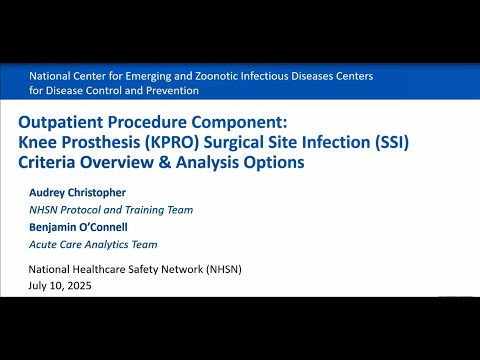
The National Healthcare Safety Network added dedicated knee prosthesis (KPRO) surgical site infection criteria to its Outpatient Procedure Component in 2025 to help ambulatory surgery centers track and report post‑operative infections more consistently.
Audrey Christopher, a member of NHSN’s Protocol and Training team, said the Outpatient Procedure Component (OPC) now includes a dedicated KPRO surgical site infection (SSI) reporting category added in 2025 to help ambulatory surgery centers (ASCs) monitor knee prosthesis procedures after policy changes increased their outpatient volume.
The change responds to a 2018 Centers for Medicare and Medicaid Services decision to remove total knee arthroplasty (TKA) from the inpatient-only list, Audrey said, which led to more TKAs occurring in ASCs. NHSN worked with ASC partners to develop the OPC KPRO SSI criteria, Christopher said, and the criteria are now available in OPC.
NHSN defines tissue depth for SSI reporting as superficial (skin and subcutaneous tissue), deep (muscle and fascia) and organ space (tissue beneath muscle or fascia). Christopher explained that organ-space SSI surveillance periods can be either 30 or 90 days depending on the NHSN operative procedure category, and then detailed the KPRO-specific organ-space criteria. Those KPRO criteria include: (A) two positive periprosthetic joint specimens with at least one matching organism identified by culture or non‑culture testing performed for clinical diagnosis; (B) organisms identified from bone by clinical testing; (C) a sinus tract communicating with the joint, abscess or other gross anatomic evidence of infection at the joint; (D) histopathologic or gross-anatomic evidence of osteomyelitis; or (E) four qualifying minor criteria such as elevated C‑reactive protein/erythrocyte sedimentation rate and synovial fluid abnormalities.
Christopher emphasized that superficial and deep SSI criteria remain essentially the same as under the prior rules, and she pointed attendees to the OPC protocol hyperlink for the full reporting criteria. In a knowledge check, Christopher confirmed that post‑discharge surveillance for superficial incisional SSI is 30 days regardless of operative procedure code category.
The presentation included a step‑by‑step demonstration of entering procedure denominator data and linking an SSI event to a procedure in the OPC application: create or select the patient record, select KPRO from the Procedure dropdown (CPT codes must be chosen from the dropdown), complete mandatory fields indicated by red asterisks, save the procedure, and—when entering an event—use the Event tab to add the OPSSI event, complete required fields, click Link Procedure, select the relevant procedure row (one procedure can be linked at a time), and save.
The NHSN presenters noted some content was adapted from the Patient Safety Component, Chapter 17, but clarified those Patient Safety Component items are not part of OPC general breast or KPRO organ-space reporting. For more details and supporting materials, the presenters directed users to the OPC surgical site infection web page and supplemental materials in the NHSN annual training community, and advised users to post questions in ServiceNow or email nhsn@cdc.gov for assistance.