Get Full Government Meeting Transcripts, Videos, & Alerts Forever!
Get email alerts on the Short Term Rentals topic
No spam. Unsubscribe anytime.
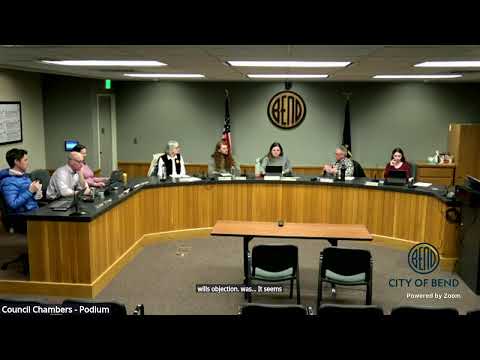
Bend planning commission recommends limiting short‑term rentals on legacy neighborhood commercial lots
Summary
After hours of public testimony, the Bend Planning Commission voted to recommend that city council amend the Bend Development Code so five legacy neighborhood‑commercial (CN) parcels follow residential short‑term rental rules—adding public notice, 500‑foot separation and the same per‑property limits.
The Bend Planning Commission on Feb. 23 voted to recommend that the City Council amend the Bend Development Code to treat five legacy neighborhood‑commercial (CN) tax lots as if their comprehensive plan designation were medium‑density residential, subjecting them to the same short‑term rental (STR) review, public notice and concentration limits as neighboring residential properties.
Planner Colleen told the commission the city council directed staff to prepare the amendment after prior hearings and public input. She said the change would move the five CN properties from a type‑1 review (no neighbor notice) to a type‑2 administrative review that requires public notice, enforces 500‑foot separation between STRs and limits the number of STRs per property to the same standard used in residential zones.
The proposal affects five tax lots across three locations in the Old Bend neighborhood, including the Iron Horse property and nearby parcels. Colleen summarized the outreach and procedural history: council direction originated in 2024, staff mailed a Measure 56 notice to affected properties on Jan. 28, posted notices Jan. 29, and tentatively scheduled a council hearing for April 15.
Neighbors and community advocates urged the change, saying STRs have already altered neighborhood character and reduced long‑term housing supply. Michael Mlandress, who lives adjacent to one affected property, told commissioners the CN parcels should “follow the rest of our development code” and asked staff to “correct this code error” so CN is not exempt from concentration limits.
Property owners, developers and investors strongly opposed the amendment. James Malarkey, who said he and partners invested in a CN parcel and operate a local business, told the commission: “The proposed amendment fundamentally changes the economic model of our project. It does not merely adjust the policy. It removes financial feasibility of what we have planned under the current code.” Co‑owner Nathan Edgars said he relied on pre‑application guidance and that retroactive changes would cause tangible financing losses.
Other property owners and real‑estate professionals warned changing allowed uses for a small set of legacy CN parcels would reduce property values, deter investment and act as a narrow, targeted constraint on redevelopment. Supporters of the amendment countered that CN was created to preserve historic neighborhood services and did not intend to open the zone to STR uses that reduce resident‑occupied housing.
After deliberation — during which commissioners discussed the policy’s history, the 250‑ vs. 500‑foot spacing debate and possible compromise language — Commissioner Suzanne Johansson moved to recommend that council amend BCD 3.6.500 to require CN properties to follow the underlying residential comprehensive plan designation’s STR review, concentration limits and per‑property caps. An amendment to allow one STR per property was discussed and a second on that amendment was later withdrawn. The commission then voted in favor of the primary recommendation.
The commission’s recommendation will be forwarded to the City Council; staff said the council hearing is tentatively scheduled for April 15. The council may accept, modify or reject the planning commission’s recommendation, and the commission’s action does not itself change the code.
Actions taken were procedural and advisory: the commission forwarded a recommendation to council rather than adopting a final code change. The record for the quasi‑judicial hearing remains open only to the extent required by appeal rules; participants were reminded that issues not raised with sufficient specificity on the record may be limited on appeal.
What happens next: the city council will consider the planning commission’s recommendation at the tentative April 15 hearing; staff noted a later second reading and an anticipated effective date in mid‑June if council adopts amendments.