Get Full Government Meeting Transcripts, Videos, & Alerts Forever!
Get email alerts on the Health Information Equity topic
No spam. Unsubscribe anytime.
Zenia Hunter, NNLM Region 6 intern, presents county-level 'community guide' to improve health information equity
Summary
Zenia Hunter, an intern with the Network of the National Library of Medicine Region 6, described a county-organized "community guide" she built to centralize public health, demographic and service-location data to help communities address health information inequities.
Zenia Hunter, an intern with the Network of the National Library of Medicine Region 6, described a web-based "community guide" she built to centralize county-level health, demographic and service-location data aimed at improving health information equity.
"I'm going to share just a little bit about my experience and about the website I've been working on called the community guide to enhance health information equity," Hunter said as she opened the presentation. She told listeners the internship required about four hours per week and combined mentorship, readings, hands-on assignments and short reflections.
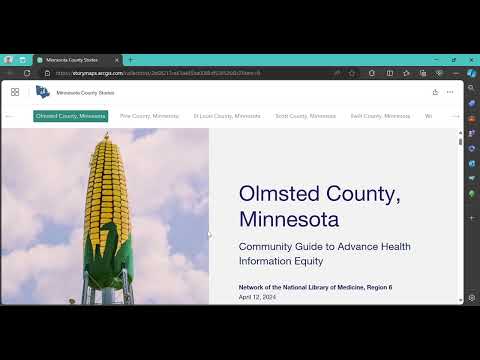
The guide, developed for NLM Region 6 and organized by state and county, compiles geographic, demographic, economic, education and health information into a narrative format that highlights local resources. "My mentor Darlene Casy created this guide as a one-stop shop for health information in NLM region 6," Hunter said. The site also embeds Census Bureau pages and links to public-data sources so users can view many statistics without navigating multiple sites.
Hunter described the technical work of building county pages and interactive maps. Drawing on public datasets, she said she used mapping software to add hospitals, clinics, schools and libraries; clicking an icon opens addresses, phone numbers and links to each facility's site. "I am particularly proud of this map," she said.
Using Census data on the Olmsted County page, Hunter reported that nearly half of the county's workforce is employed in educational services, health care and social assistance, and that the Mayo Clinic drives much of the local economy. She also said the county ranks well on several health measures but noted a higher share of adults reporting depression than state and national averages — a finding she said comes from the county health needs assessment embedded in the guide.
Hunter credited mentors and technical support for the internship, thanking Erica Lake and Darlene Casy for mentorship and Abby Dow for technical assistance, and acknowledged Region 6 of the Network of the National Library of Medicine for making the program possible.
Hunter said the internship expanded her data and visualization skills through both guided assignments and optional workshops, including a two-day data analysis and visualization course she completed.
The presentation did not include a direct link to the public guide; Hunter described the site as a resource hosted through NLM Region 6 and demonstrated its county pages and embedded public-data tools during her talk. The presentation concluded with Hunter's acknowledgements and thanks.